Car dealerships today generate more leads than ever before. Customers search for vehicle listings and dealerships online, fill out forms, send chat messages, and call dealerships after hours. However, generating leads is only half of the battle — converting them into showroom visits and then into final sales, and this requires a system to execute this process.
That system is the automotive BDC (Business Development Center).
A well-run BDC ensures every lead receives a timely response, every appointment is confirmed, and every opportunity is followed up until it either converts or is truly lost. For dealerships aiming to grow revenue without endlessly increasing marketing spend, scaling the BDC is one of the most effective operational strategies available.
What Is an Automotive BDC?
An automotive BDC (Business Development Center) is a dedicated team within a dealership, either in-house or outsourced, responsible for managing inbound and outbound customer communications, including internet leads, phone calls, appointment scheduling, and follow-ups.
Most dealerships operate two core BDC functions:
Sales BDC Handles internet leads, phone inquiries, and appointment setting to drive showroom traffic.
Service BDC Manages service reminders, maintenance scheduling, recall outreach, and customer retention.
Together, these teams act as the bridge between a dealership’s digital visibility and the physical showroom. Research from the 2024 Cox Automotive Car Buyer Journey Study shows buyers spend over 13.5 hours in the vehicle shopping process, with much of that time spent online. The BDC makes sure that the online interest turns into real dealership visits.
Why Scaling Matters Now — The Business Case for Growing Your BDC
Dealerships invest in digital marketing to generate good leads, but many dealerships fail because their internal systems cannot handle high demand. This creates a gap between leads generated and revenue captured
Industry benchmarks highlight this problem clearly.
The average dealership lead-to-sale conversion rate is about 5.72%, while service departments convert at approximately 12.61%. This indicates a large percentage of potential customers never complete the buying journey.
One of the most important factors affecting conversions is speed-to-lead.
Research shows that 78% of customers buy from the company that responds first. Still, many of the dealerships' response times are not consistent. According to a 2025 lead response study covering 1,700 dealerships, only 61% of dealerships replied within 15 minutes, while 19% of them took over an hour.
Slow responses mean lost customers. They do not come back
Phone interactions also reveal important conversion differences. Phone leads achieve an appointment set rate of around 74–75%, compared with about 40% for internet leads. This means dealerships must follow up quickly and effectively on online inquiries to maximize appointment opportunities.
Customer expectations are also increasing. The 2024 Cox Automotive Car Buyer Journey Study reported 75% satisfaction with the car shopping experience and 81% satisfaction with dealership experiences, both record highs.
Another insight comes from the S&P Global Mobility Vehicle Buyer Journey Study, which found that 60% of consumers drove past their closest dealership to visit one offering a better digital experience.
In other words, scaling your BDC doesn’t just improve conversions — it can help attract customers away from competitors.
A simple self-diagnostic can help determine if your dealership needs to scale its BDC:
- Your team cannot respond to every lead within 5 minutes
- Your appointment show rate is below 50%
- Salespeople handle their own follow-ups
- Response times increase as lead volume grows
If these symptoms exist, your BDC has likely not scaled to match your marketing efforts.
Choosing Your Scaling Model: In-House, Outsourced, or Hybrid
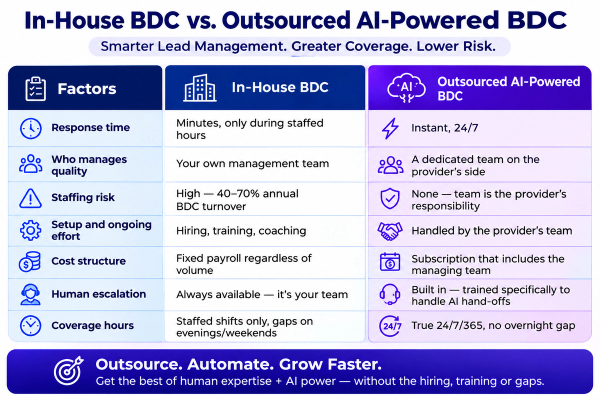
When dealerships expand their BDC operations, they typically choose one of three models: in-house, outsourced, or hybrid.
Each approach has advantages and trade-offs depending on lead volume, budget, and management preferences.
In-House BDC
An in-house BDC means the dealership hires and manages its own team of representatives.
The average dealership BDC representative earns about $37,575 annually, with typical salaries ranging from $30,000 to $54,000 depending on experience and location.
Once benefits, payroll taxes, workspace, and technology are included, the total cost per representative can reach $3,500–$4,500 per month. A team of three representatives plus a manager can exceed $180,000 annually.
Despite the cost, many dealerships prefer this model because it offers:
- Full control over communication processes
- Strong alignment with dealership culture
- Direct CRM access and coordination with sales teams
The primary and important challenge is employee turnover, which is relatively high in all BDC roles.
Outsourced BDC
Outsourced BDC providers have an external system for handling the lead responses and appointment scheduling,
This model allows dealerships to scale staffing quickly without hiring additional employees. Many outsourced providers also offer a 24/7 working system, making sure that leads are handled outside the normal business hours.
Advantages include:
- Lower fixed staffing costs
- Faster scalability during high lead periods
- Access to specialized training and systems
However, outsourcing may limit direct control over communication style and dealership-specific knowledge.
Hybrid BDC
The hybrid model combines an internal BDC team with outsourced support.
In this structure:
- In-house staff handle high-value interactions
- Outsourced teams manage overflow leads and after-hours communication
Industry analysts predict hybrid models will become increasingly common because they balance cost efficiency with operational control.
How to Staff Your BDC for Growth
Staffing is one of the most important factors when using a BDC.
A widely used industry benchmark recommends one BDC representative for every 150–200 leads per month. When representatives exceed this workload, response times slow and follow-ups become inconsistent and are delayed.
Service BDC operations also require significant communication capacity.
On average, a service BDC agent handles around 70 inbound calls and 160 outbound calls daily, including appointment reminders and follow-ups.
Many dealerships underestimate how quickly communication volume increases as marketing campaigns expand.
Key BDC Roles
As the department grows over time, several roles become essential and important.
BDC Manager
The BDC manager checks overall performance metrics, CRM workflows, and training programs. This role is very important because effective training of the staff has a direct impact on the appointment conversion rates of customers.
BDC Representatives
Representatives handle customer communication across phone, email, text messaging, and live chat. The primary objective of a BDC representative is to convert the inquiries into appointments.
BDC Trainer Dealerships with five or more representatives benefit from a dedicated BDC trainer who manages onboarding and ongoing skill development of the representatives so they work efficiently.
Addressing the Turnover Challenge
Employee turnover is a big challenge in dealership operations nowadays.
Industry data indicates dealership turnover rates average 34–39% across positions, with some sales roles experiencing even higher churn.
Replacing an employee can cost nearly 33.3% of their annual salary, accounting for recruiting, onboarding, and lost productivity in the department, which is a big loss. For a BDC representative earning $37,575 annually, that equates to about $12,500 per departure
Dealerships can reduce turnover by implementing three key strategies:
- Career pathing – Create opportunities for BDC representatives to transition into sales, finance, or management roles.
- Performance-based compensation – Reward appointment show rates and sales conversions rather than only call volume.
- Structured onboarding – New hires should spend time shadowing both sales and service departments before managing customer interactions.
The Metrics That Drive Scalable BDC Performance
Scaling a BDC successfully requires tracking specific performance indicators. These metrics help dealerships evaluate whether their lead management system is converting opportunities effectively.
Key Automotive BDC Metrics
- Lead Response Time Target: under 5 minutes. Responding within five minutes is 10 times more effective than waiting ten minutes.
- Appointment Set Rate Phone leads average about 74% appointment set rates, while internet leads average around 40%.
- Appointment Show Rate Industry benchmarks show approximately 41% show-to-sale conversion from combined lead sources.
- Contact Rate Many sales require five or more follow-ups, yet most salespeople stop after four attempts.
- Lead-to-Sale Conversion Rate Average dealership conversion rates range between 3% and 5%, while top performers exceed 10%.
- Cost Per Lead and Cost Per Sale Automotive PPC campaigns generate leads at roughly $42.95 per prospect, while full digital marketing programs average $250–$283 per lead.
Recommended Tracking Schedule
Daily monitoring:
- Lead response time
- Contact rate
Weekly review:
- Appointment set rates
- Appointment show rates
Monthly analysis:
- Lead-to-sale conversion
- Cost per sale
Technology and Tools That Enable BDC Scaling
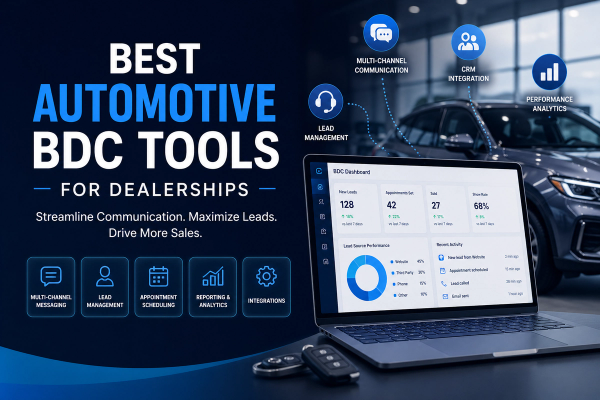
Technology plays a major role in enabling BDC growth. As lead volumes increase, manual processes quickly become inefficient.
CRM Systems
The CRM acts as the central operating system of the BDC. Every lead, interaction, and follow-up should be tracked within the CRM platform.
The automotive CRM market is projected to grow from $6.13 billion in 2024 to $8.81 billion by 2028, reflecting its increasing importance in dealership operations.
AI-Powered Automotive BDC Software
Artificial intelligence tools can:
- Respond to leads instantly
- Score leads based on purchase intent
- Automate reminders and follow-ups
Industry forecasts suggest AI could manage up to 50% of routine BDC tasks by 2026, allowing representatives to focus on higher-value conversations.
Omnichannel Communication Platforms
Modern BDC operations must manage communication across multiple channels:
- Phone
- SMS/text
- Live chat
- Social media messaging
Text messaging, in particular, has become one of the most effective methods for appointment confirmations and reminders.
Call Analytics and Coaching Tools
Call tracking and analytics tools allow managers to review conversations, monitor performance, and identify coaching opportunities across the BDC team.
Common Scaling Mistakes and How to Avoid Them
Even dealerships investing in BDC growth sometimes encounter operational challenges.
Scaling Leads Without Scaling Staff
Increasing marketing budgets without increasing BDC staffing results in slower response times and missed opportunities.
Measuring Activity Instead of Results
Tracking call volume alone can be misleading. Dealerships should prioritize appointment show rates and lead-to-sale conversions.
Ignoring the Service BDC
Many dealerships scale their sales BDC but neglect service operations. Yet service appointments help maintain customer relationships and generate repeat sales opportunities.
Poor Lead Handoff Processes
Without clear procedures for transferring qualified leads to the sales team, internal conflicts can arise.
Lack of Career Growth Opportunities
BDC roles can feel like dead-end positions if employees cannot see advancement opportunities. Clear career pathways improve retention.
Generic Lead Responses
Studies show many dealerships respond to inquiries without providing pricing details, payment estimates, or vehicle photos — which significantly reduces engagement
A Scaling Roadmap: From Startup BDC to High-Performance Department
Scaling a BDC typically occurs in stages as lead volume increases.
Stage 1 — Foundation (Under 300 Leads per Month)
- 1–2 BDC representatives
- CRM lead tracking
- 5-minute response SLA
- Defined sales handoff processes
Many dealerships use outsourced or hybrid models at this stage.
Move to Stage 2 when:Response times exceed five minutes or appointment set rates decline.
Stage 2 — Growth (300–600 Leads per Month)
- Dedicated BDC manager
- 3–4 representatives
- Separate sales and service BDC roles
- Omnichannel communication tools
- AI-assisted lead routing
Move to Stage 3 when: Lead volume consistently exceeds 600 leads per month.
Stage 3 — Scale (600–1,000+ Leads per Month)
- Full in-house BDC team
- 5–8 representatives
- Advanced analytics and call coaching
- Performance-based compensation plans
- Structured training and career paths
Dealership employment reached 1.13 million employees in 2024, with the average dealership employing around 65 staff members. As the market stabilizes, many dealerships are expanding BDC operations because they deliver strong returns on investment.
Start Scaling Where You Are
Scaling an automotive BDC isn’t simply about hiring more people. Successful dealerships build repeatable systems, track the right metrics, and grow staffing in proportion to lead volume
The dealerships that invest in scalable BDC operations today will be the ones best positioned to capture tomorrow’s customers — especially as more buyers choose dealerships based on digital experience, responsiveness, and convenience rather than location alone.

Manan Bhalodia
Expert in automotive AI solutions and customer service optimization. Passionate about helping automotive dealerships leverage technology for growth.