What Are Automotive BDC Tools?
Automotive BDC tools are the software platforms and technologies that power a dealership’s Business Development Center — the dedicated team responsible for managing leads, customer communications, and appointment setting. These tools include CRM systems, call tracking software, AI chatbots, VoIP phone systems, and communication platforms that help agents respond faster, track performance, and convert more leads into showroom visits.
If you’re new to the concept of an automotive BDC, think of these tools as the engine behind every lead response, follow-up, and appointment booked — not just a support system, but a revenue driver.
The reality today? Speed wins.
Why Speed Matters in BDC
Responding to a lead within 5 minutes can make a dealership 21–100x more likely to convert it. Yet many dealerships still take over an hour — or never respond at all. That gap between customer expectation and dealer execution is exactly where deals are lost.
Market Growth of Dealership Software
The modern dealership stack has evolved far beyond spreadsheets and desk phones. According to Research Nester (2025), the automotive dealership software market was valued at $6.1 billion in 2025 and is projected to reach $12.5 billion by 2035, growing at a CAGR of 7.5%.
(Source: Research Nester Report)
The 6 Categories of Automotive BDC Tools
To make sense of the landscape, don’t think of BDC tools as a random list of software. Think of them as a stack of layers — starting with foundational systems and building up to advanced capabilities.
DMS Integration Layer (The Foundation)
Every BDC tool depends on clean, accurate data — and that data lives in your Dealer Management System (DMS).
Platforms like CDK Global and Reynolds & Reynolds store:
- Customer records
- Vehicle purchase history
- Service data
While the DMS isn’t a BDC tool itself, nothing works properly without it.
CRM Systems (The Operational Backbone)
Your CRM is where everything comes together.
It:
- Centralizes all lead data
- Tracks every customer interaction
- Manages follow-up workflows
- Provides pipeline visibility
Dealership-focused CRMs like VinSolutions, Elead, DriveCentric, and Tekion are designed specifically for automotive workflows — unlike general tools like Salesforce or HubSpot.
Without a solid CRM, your BDC is essentially flying blind.
For a better understanding, read: How Automotive BDC Works in Modern Car Dealerships
BDC Communication Platforms (The Execution Layer)
This is where BDC agents actually work.
These platforms combine:
- Calling
- Texting
- Campaign management
- all in one interface.
Unlike CRMs, they’re built around the daily rhythm of a BDC agent: high call volume, rapid follow-ups, and structured outreach.
Tools like Volie and Sweet Relish are designed to:
- Increase outbound attempts
- Improve response times
- Standardize communication workflows
For growing dealerships, this layer becomes essential.
Call Tracking & Intelligence Software (The Insight Layer)
Phone calls are still one of the highest-converting lead sources in automotive.
These tools help you answer critical questions:
- Which marketing campaigns drive calls?
- Are calls being handled properly?
- Where are opportunities being missed?
Features include:
- Call recording and transcription
- AI-powered call scoring
- Marketing attribution
Why this matters:Phone leads convert at nearly double the rate of internet leads.
If you’re not tracking calls properly, you’re missing one of your most valuable data sources.
(Source: CallSource Automotive Industry Report, 2023)
AI-Powered BDC Assistants (The Scale Layer)
AI tools are designed to handle:
- After-hours lead responses
- Initial inquiries
- Appointment scheduling
- Automated follow-ups
They’re especially useful for:
- Capturing leads when your team is offline
- Maintaining consistent follow-up
- Reducing manual workload
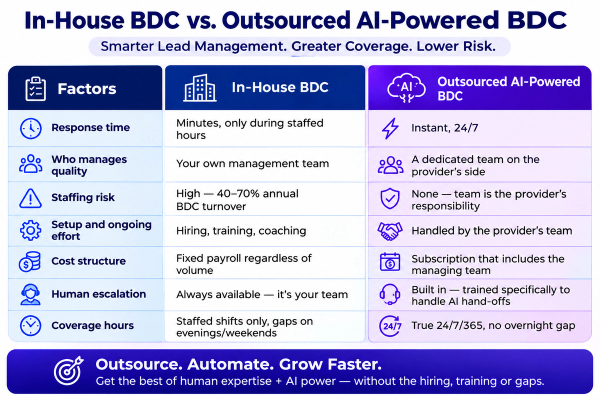
But here’s the reality:AI works best as a support system — not a replacement for humans.
The most effective dealerships use a hybrid model:
- AI handles speed and volume
- Humans handle nuance and closing
You can explore more here: Best Automotive BDC Software for Dealerships
VoIP / Dealership Phone Systems (The Infrastructure Layer)
Your phone system determines whether leads even reach your team.
Modern VoIP systems provide:
- Call routing and queue management
- Department-level visibility
- Missed call tracking
One missed call can mean thousands in lost revenue — so this layer matters more than most dealerships realize.
How to Choose the Right BDC Tools for Your Dealership
If you're planning for long-term growth, also see: How to Scale Your Dealership with an Automotive BDC
Here’s where most articles fail — they list tools, but don’t tell you what’s right for you.
Let’s fix that.
Small / Independent Dealerships
Profile:
- 1 location
- Under 100 leads/month
What you actually need:
- A strong automotive CRM with built-in texting/email
- Basic follow-up automation
What can wait:
- AI tools
- Advanced call tracking
At this stage, speed comes from people, not technology.
A trained agent responding within 5 minutes will outperform any automation.
Mid-Size Franchise Dealerships
Profile:
- 1–3 rooftops
- 200–500+ leads/month
What changes:
- Volume increases
- Manual processes start breaking
What you need:
- BDC communication platform (like Volie)
- Call tracking with AI insights
- Optional AI assistant for after-hours
This is where tools start acting as force multipliers.
Large Dealer Groups
Profile:
- 4+ locations
- High lead volume across locations
What you need:
- Enterprise CRM with multi-store visibility
- Centralized BDC platform
- Advanced call intelligence
- Integrated AI systems
At this level, the challenge isn’t generating leads — it’s managing complexity at scale.
The Priority Rule
If you can only improve one thing:
Improve your response time.
Dealerships that respond faster win consistently.
Before buying new tools, ask:
“Will this help us respond faster and more consistently?”
If the answer is no, it’s not a priority.
What BDC Tools Actually Cost
Let’s talk about what most vendors won’t clearly tell you.
BDC Agent Salary
$37,575/year average (ZipRecruiter, 2025)
$51,554/year average, including commission (Glassdoor, 2025)
CRM Systems
$300–$900/month (AutoRaptor, Selly, Frazer)$1,000–$3,000/month (DealerSocket, Elead, Salesforce) (Source: AutoRaptor CRM Comparison, 2025)
Call Tracking Software
$45–$50/month (basic)$90/month (with conversation intelligence)$135–$175/month (advanced)
(Source: CallRail Pricing, 2026)
Will Your BDC Tools Actually Talk to Each Other?
This is where most implementations go wrong.
Every vendor promises “seamless integration.”
Reality? It’s messy.
Your stack might include:
- DMS
- CRM
- Phone system
- Marketing tools
- AI chatbot
If these don’t connect properly, you’ll see:
- Duplicate leads
- Missing call data
- Broken follow-ups
- Scheduling errors
Questions You Must Ask Vendors
Before buying anything, ask:
- Does this integrate with my DMS?
- Is the CRM sync bi-directional?
- What happens during data conflicts?
- Is there an open API?
Over 14% of leads never make it into CRMs.
(Source: NADA CRM Data Studies, 2022)
Why This Matters
Over 14% of leads never make it into CRMs - often due to broken integrations.
That’s not a tool problem.That’s a system problem.
The Tradeoff
You have two choices:
All-in-one platform
- Fewer integration issues
- Less flexibility
Best-of-breed tools
- More flexibility
- More integration complexity
There’s no universal right answer — only what fits your dealership.
AI BDC Tools: What They Can (and Can’t) Do Today
AI is everywhere in automotive right now.
But there’s a gap between expectation and reality.
H3: Where AI Works Well
- Instant lead response (especially after hours)
- Appointment scheduling
- Consistent follow-ups
- Call transcription and scoring
AI shines in speed and consistency.
The Reality
Most dealerships are still figuring out how to use AI effectively.
The winning approach today: AI + Human hybrid model
Quick Self-Check
If your team isn’t responding within 15 minutes during business hours:
AI is not your biggest problem. Your process is.
How to Measure Whether Your BDC Tools Are Working
The biggest mistake you can make?
Investing in tools without measuring results.
Here’s what to track:
CRM Metrics
Lead-to-appointment rate: 10–15% Response time: Under 15 minutes
(Source: NADA)(Source: DAS Technology Lead Response Study)
Call Metrics
Missed call percentage: Under 10%
Appointment Metrics
Appointment show rate: 50–60%
5 Mistakes Dealerships Make with BDC Tools
Software Can’t Fix a Broken Workflow
A lot of dealerships invest in expensive BDC tools expecting instant results — but the truth is, tools don’t fix broken processes. If your team doesn’t have a clear follow-up system in place, you’ll still miss lead, just with better tracking. For example, spending $900/month on a platform won’t help if no one knows when or how to follow up. Before you invest in any tool, map out your entire lead journey — from first inquiry to booked appointment. If that process isn’t clear, no software will magically solve it.
Too Many Tools Create Confusion, Not Efficiency
More tools don’t always mean better results. In fact, they often create chaos. Imagine this: your CRM sends an automated message, and your communication platform sends another one right after. The customer ends up getting the duplicate — or even conflicting — messages. It feels messy and unprofessional. The smarter approach is to simplify. Review your current tools and clearly decide which platform is responsible for what — lead capture, first response, follow-ups, and confirmations.
But tools alone don’t win deals; the right process, people, and technology deliver great results.
AI Will Scale Your Problems If Your Process Is Weak
AI sounds like the perfect solution: faster replies, automation, and less manual work. But here’s the catch: AI only amplifies what already exists. If your follow-up process is messy or inconsistent, AI will make it worse, at scale. There have been cases where dealerships implemented AI before fixing their scripts, and the customers ended up receiving vague or confusing messages. The result? More confusion and lower appointment show rates. The right approach is simple: fix your process first, then use AI to make it faster and more consistent.
Cheap Tools Become Expensive When They Create Data Silos
Choosing a cheaper tool might save money upfront, but it can cost you more in the long run, especially if it doesn’t integrate with your CRM. For example, if your call tracking system isn’t connected, your team won’t see previous conversations when a lead calls back. That means asking the customer to repeat everything, which is frustrating and often enough for them to move on to another dealership. In a competitive market, that small gap can cost you the deal. That’s why every tool you use should connect back to one central system, ideally your CRM.
Conclusion
Automotive BDC tools are not just software; they are a growth lever for modern dealerships.
Every lead is a person making a decision. They’re comparing options, forming impressions, and often choosing the dealership that responds first, communicates clearly, and makes the process feel easy. That’s where your BDC tools quietly do their most important work — not just managing data, but enabling better customer experiences at scale.
But here’s the truth: most vendors won’t emphasize: No tool, no matter how advanced, can replace clarity in your process or accountability in your team.
The dealerships that consistently win aren’t the ones with the most software — they’re the ones where:
- Every lead has a defined journey
- Every follow-up has a purpose
- Every team member knows exactly what to do next
Technology simply amplifies that foundation.
When your systems are aligned, your response times shrink. Conversations become more relevant. Follow-ups feel intentional instead of repetitive. And over time, those small improvements compound into something much bigger: higher appointment rates, better show rates, and stronger customer trust.
On the other hand, when your tools are disconnected, or your process is unclear, even the best platforms can create noise instead of results — missed opportunities hidden behind dashboards and automation.
So before adding another tool, take a step back and ask:
- Are we fast enough?
- Are we consistent enough?
- Are we making it easy for the customer to choose us?
Because in today’s dealership landscape, the competitive edge isn’t just technology — it’s how well your people, processes, and tools work together.
Your BDC doesn’t just support sales; it becomes one of the most reliable growth engines in your entire dealership.

Manan Bhalodia
Expert in automotive AI solutions and customer service optimization. Passionate about helping automotive dealerships leverage technology for growth.