What Is an Automotive BDC?
An automotive BDC (Business Development Center) is a specialized dealership department dedicated to managing all inbound and outbound customer communications — including phone calls, internet leads, emails, texts, and chat — to qualify prospects, schedule appointments, and nurture long-term customer relationships for both sales and service departments.
The role of the automotive BDC has become critical as buyer behavior has shifted. Today, most customers interact with a dealership before stepping inside it — through a call, a website form, or a chat inquiry. That first interaction is no longer handled by a salesperson on the floor — the BDC owns it.
A dealership BDC is not just a call center or a receptionist desk. It is a structured team with defined workflows, scripts, CRM systems, and performance metrics. Typically, it includes a BDC manager and multiple trained representatives focused on one outcome: converting conversations into appointments.
Modern dealerships typically operate one of three models:
- In-house BDC
- Outsourced BDC
- Hybrid (in-house + external support)
This article goes deeper into how a BDC actually works — beyond definitions — so you can understand its real operational impact.
How Sales BDC and Service BDC Work Together
A modern automotive BDC is not a single function — it operates across two interconnected systems: sales and service. Understanding how these two sides work together is key to understanding how dealerships maximize revenue.
Sales BDC: Driving Showroom Traffic
The sales BDC handles all incoming purchase-related inquiries:
- Website leads and third-party platforms
- Phone calls about vehicle availability and pricing
- Social media inquiries
Their job is not to sell the car — it’s to set the appointment.
A typical workflow includes:
- Responding quickly to new leads
- Qualifying the customer (budget, timeline, trade-in, intent)
- Recommending vehicles
- Scheduling test drives
- Executing structured follow-ups across phone, email, and text
The focus is simple but powerful: turn interest into a confirmed visit.
Service BDC: Driving Long-Term Revenue
The service BDC handles everything after the sale — and often generates more lifetime value than the initial deal.
Key responsibilities include:
- Scheduling maintenance and repair appointments
- Sending service reminders based on mileage or time intervals
- Managing recall outreach
- Following up on declined services
- Confirming appointments and reducing no-shows
- Conducting customer satisfaction follow-ups
The Connection: A Continuous Customer Lifecycle
The real power of a dealership BDC comes from how these two sides connect.
A customer who enters through the sales BDC doesn’t disappear after purchase — they transition into the service BDC ecosystem for years. At the same time, service interactions often create new sales opportunities.
Example:
- A customer declines a major repair due to cost
- The service BDC identifies this as a replacement opportunity
- The lead is passed back to the sales team
From the customer’s perspective, this feels seamless. Behind the scenes, it’s the BDC — powered by CRM data — keeping everything connected.
How an Automotive BDC Operates Day to Day
To truly understand how an automotive BDC works, you need to see it in motion. A high-performing BDC runs on structure, timing, and discipline.
Morning: Speed Wins (8:00 – 10:00 AM)
Speed is critical. In fact, contacting a lead within 5 minutes makes you 21x more likely to qualify them and up to 100x more likely to connect compared to waiting an hour, according to Harvard Business Review and MIT research. The faster the response, the higher the chance of converting interest into action.
The day starts inside the CRM.
BDC reps log in and immediately prioritize:
- Overnight internet leads
- Missed opportunities from the previous day
- Same-day appointment confirmations
Speed is critical. The faster the response, the higher the chance of connecting with the customer. Delays often mean the lead has already moved on to another dealership.
Delays often mean the lead has already moved on to another dealership — 78% of customers end up buying from the first company that responds meaningfully, making response speed a direct competitive advantage.
Source: Harvard Business Review / MIT InsideSales. com
Source: Vendasta / Lead Connect Survey (cited across multiple industry sources)
Midday: Managing Inbound Demand (10:00 AM – 1:00 PM)
This is peak call volume.
The BDC handles:
- Sales inquiries (pricing, availability, financing)
- Service booking calls
- General dealership questions
Reps follow structured scripts to guide conversations toward a single goal: booking an appointment.
Unlike salespeople, BDC reps are not negotiating deals — they are controlling the flow of communication and ensuring that no opportunity is lost.
Afternoon: Outbound Growth (1:00 PM – 4:00 PM)
This is where proactive revenue happens.
The BDC shifts to outbound campaigns:
- Service reminders
- Lease-end follow-ups
- Equity mining (customers with high trade-in value)
- Re-engaging inactive leads
Each call is targeted, not random — driven by CRM data and campaign strategy.
Late Afternoon: Locking in Tomorrow (4:00 PM – 6:00 PM)
The final hours focus on:
- Confirming next-day appointments
- Following up with no-shows
- Updating CRM records
- Preparing the next day’s task queue
BDC managers review daily KPIs:
- Calls made
- Contacts reached
- Appointments set
- Show rates
This daily review isn’t just a routine — it directly impacts performance. Dealerships that actively track BDC metrics see up to 30% more appointments booked and 25% higher close rates.
Source: Spyne, 12 Key Automotive BDC Metrics, Jan 2026
When teams consistently measure what’s happening, they can quickly spot gaps, adjust follow-up
Behind all of this is a tech stack:
- CRM systems
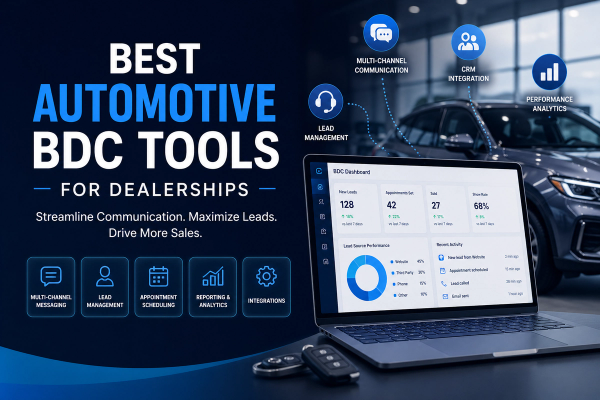
- Call tracking software
- Email and SMS automation tools
The entire operation is designed for consistency at scale.
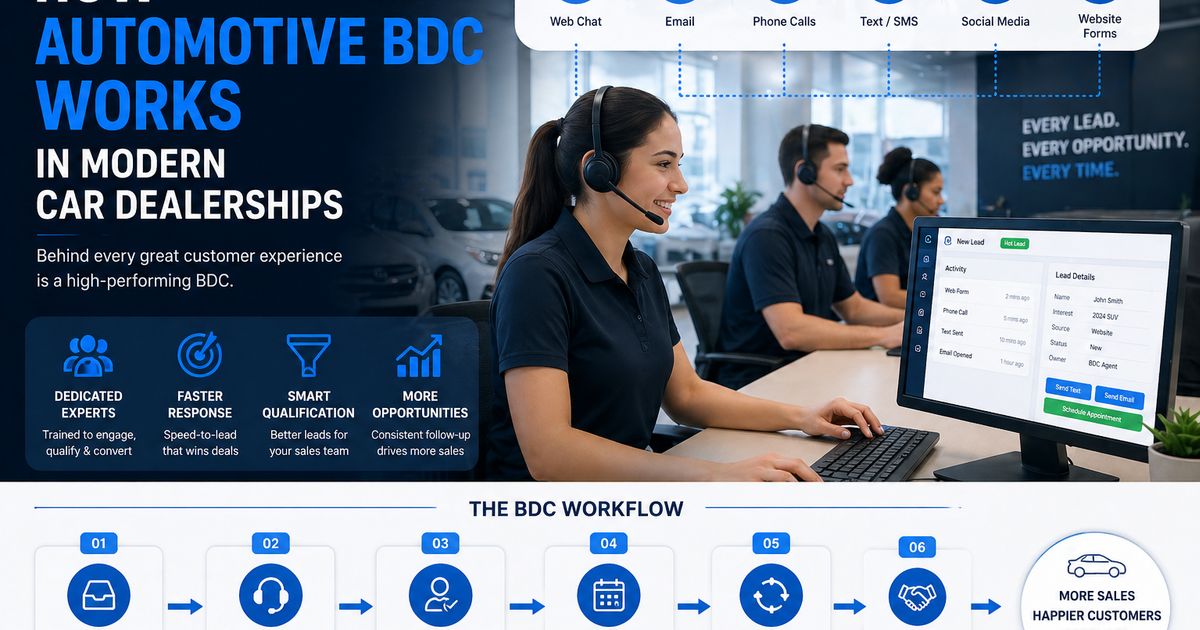
How a Lead Moves Through the Automotive BDC
Every lead that enters a dealership follows a structured journey. Understanding this lifecycle is key to improving conversion rates.
Stage 1: Lead Entry
Leads come from:
- Website forms
- Phone calls
- Live chat
- Third-party platforms
The CRM automatically assigns the lead to a BDC rep.
Stage 2: First Response
This is the most critical moment.
A strong response:
- References the exact vehicle
- Includes pricing or payment guidance
- Offers alternatives
- Asks for an appointment
Weak responses — like generic auto-replies — immediately reduce trust.
Stage 3: Qualification and Follow-Up
The BDC works to understand:
- Budget
- Timeline
- Trade-in status
- Purchase intent
This stage includes multi-touch follow-up across channels — often 8–12 attempts over two weeks.
This stage includes multi-touch follow-up across channels — often 8–12 attempts over two weeks. This level of persistence is critical, as 80% of sales require at least 5 follow-ups, yet 92% of salespeople give up after just 4 attempts — and nearly half give up after the first contact.
Source: GrowthList / Marketing Donut / Intelemark (compiled across multiple studies
Stage 4: Appointment Set
The lead becomes tangible when:
- A date and time are confirmed
- The purpose is defined (test drive, appraisal, etc.)
The sales team is notified instantly.
Stage 5: Confirmation and Show
Appointments are reinforced through:
- 24-hour reminders
- Same-day confirmations
No-shows are followed up on immediately.
Stage 6: Handoff to Sales
When the customer arrives:
- The salesperson already knows their details
- The conversation continues — not restarts
At this point, the BDC has done its job for the sale, but the lifecycle continues into service.
Benchmarks That Matter
If your numbers fall below these, the issue is usually process - not lead quality.
Phone leads aren’t just another channel — they’re often your highest-converting opportunity. In fact, dealerships are seeing appointment-setting rates as high as 74% for phone leads, compared to around 40% for internet leads (April 2025). When a customer picks up the phone, they’re usually further along in their decision-making — and how your team handles that call can make or break the deal.
Source: Foureyes Automotive Dealer Benchmark Report, Q4 2024 – April 2025
Appointment Show-to-Sale Performance (Foureyes Data) Not every appointment turns into a sale — and the gap is bigger than most dealerships expect.
Source: Foureyes Dealership Data Study, ~700 U.S. dealerships, Feb 2024
According to Foureyes, only about 30–40% of shown appointments actually convert into sales, meaning a large portion of opportunities are still being lost even after the customer walks in.
Source: Maritz Performance Manager / Internet Sales FAQ
Internet lead close rate: 10%–15% is commonly cited; a realistic improvement target is incremental from the current baseline, says Maritz Performance Manager.
Inbound phone calls are one of the most valuable opportunities a BDC team handles. With the right training and process, around 55–65% of inbound calls should convert into confirmed appointments. When conversion falls below that range, it’s usually not a lead quality issue — it’s a process or training gap.
Source: Proactive Training Solutions, Appointment Set Rate Benchmarks, 2025
Where the BDC Fits in the Dealership Ecosystem
A BDC doesn’t operate in isolation — it sits at the center of dealership operations.
BDC and Sales Floor
This relationship often creates friction.
Sales teams may feel:
- Leads are being “taken” from them
- Appointments are of low quality
BDC teams may feel:
- Their efforts are undervalued
- Appointments are mishandled
The solution is alignment:
- Clear ownership rules
- Fair compensation structures
- Strong leadership support
BDC and Service Department
The BDC reduces pressure on service advisors by:
- Handling inbound calls
- Managing scheduling
- Driving outbound campaigns
This allows advisors to focus on in-shop customers while the BDC drives future business.
BDC and Marketing
Marketing generates leads — but the BDC converts them.
A disconnected BDC means:
- Wasted ad spend
- Poor lead handling
A connected system creates a feedback loop:
- Which sources convert best
- Which campaigns underperform
BDC and F&I
Early qualification by the BDC:
- Speeds up financing
- Improves customer experience
- Reduces time spent in the dealership
Common Reasons Automotive BDCs Fail
Many dealerships implement a BDC — but fail to make it work.
One of the biggest things is that managing a BDC requires focus, structure, and process — especially when you consider the scale most dealerships operate at. The average franchised dealership employs around 65 people, with total U.S. dealership employment reaching 1.13 million in 2024 (the highest since 2019).
Source: NADA 2025 Midyear Report (via CBTNews, Oct 2025)
Within that structure, the BDC isn’t a standalone function — it sits at the intersection of sales, service, and marketing, making coordination and clear workflows critical to avoid dropped leads and miscommunication.
Another common problem is that many dealerships underestimate how serious turnover really is. Executives often believe turnover is around 22%, but in reality, it’s over 42% — and in sales roles, the gap is even bigger: 40% perceived vs. nearly 80% actual (NADA).
When the problem is underestimated, it rarely gets the investment or structural changes it actually needs.
Source: DrivingSales HCM Study / NADA (viaDealertrack guide)
Under-resourcing is often a symptom of a deeper issue: retention. While about 77% of dealership employees stay through the first year, only 49% are still there after three years (2024) — which means nearly half the team turns over just as they become truly effective. That’s exactly why investing in BDC staffing, training, and structure isn’t optional — it’s essential for long-term performance.
Source: 2025 NADA Dealership Workforce Study
Pay plan inconsistency also drives turnover. Without clear incentives, BDC performance becomes unstable and unpredictable.
Staffing is becoming one of the biggest hidden challenges in dealership performance. Overall dealership turnover reached 42% in 2024 — a three-year high — while sales consultant turnover jumped by 13 percentage points, marking the sharpest increase in recent years.
Source: 2025 NADA Dealership Workforce Study (2024 calendar year data)
This level of churn doesn’t just impact hiring — it directly affects lead handling, follow-up consistency, and ultimately, lost revenue.
The absence of process almost always shows up as lost opportunities. In fact, around 14% of automotive sales leads never make it into dealer CRMs at all, meaning they’re never followed up on, tracked, or converted.
Source: Foureyes Benchmark Report, 2022 (also cited in Demand Local)
Finally, internal conflict — especially from the sales floor — can undermine the entire system. Without leadership alignment, even a well-designed BDC will struggle.
How AI and Automation Are Reshaping the Automotive BDC
The modern automotive BDC is evolving — not being replaced — by AI.
What AI Handles Well
AI is already effective at:
- Instant lead responses (24/7)
- Chat-based conversations on websites
- Automated appointment scheduling
- Follow-up reminders
- Lead prioritization
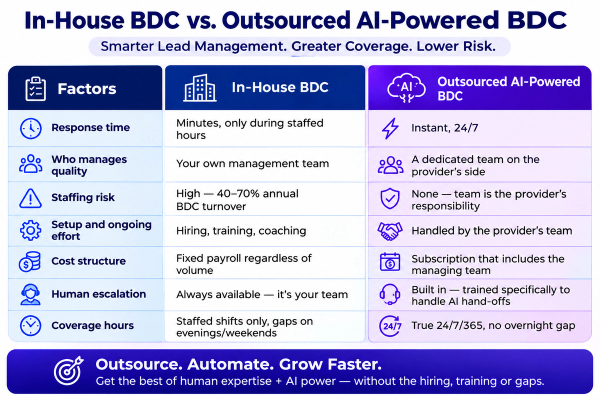
It solves two major BDC challenges:
- Slow response times
- Inconsistent follow-up
What Humans Still Do Better
Human reps remain essential for:
- Negotiations
- Complex objections
- Emotional conversations
- Relationship building
The Hybrid Model
The most effective BDCs use a hybrid approach:
- AI handles speed and repetition
- Humans handle judgment and relationships
This creates a system that is both efficient and personal.
Simple Reality Check
If your dealership:
- Cannot respond to leads after hours
- Relies on manual follow-up
- Spends more time on data entry than on conversations
Then automation is no longer optional.
But if you think AI alone can replace real conversations in a high-value purchase decision, it won’t.
Does Your Dealership Need an Automotive BDC?
Not every dealership needs a full-scale BDC — but most need some version of it.
You Likely Need a BDC If:
- Leads are not answered within 15 minutes
- Calls frequently go unanswered
- Follow-up depends on individual salespeople
- Service call volume overwhelms advisors
- Appointment conversion is below 30%
You May Not Need One If:
- You operate at very low volume
- Your team can handle all leads consistently
- Your processes are already structured and effective
The Decision Framework
Start by measuring:
- Lead response time
- Call answer rate
- Appointment-to-show ratio
If these fall below industry benchmarks, a BDC — whether in-house, outsourced, or hybrid- will likely pay for itself by recovering lost opportunities.
An automotive BDC is not just a department — it is the system that connects customer intent to dealership action.
When it works:
- Leads are handled quickly
- Appointments increase
- Customer experience improves
- Revenue becomes predictable
When it doesn’t:
- Opportunities are lost silently
- Marketing spend is wasted
- Teams blame each other
Understanding how a BDC actually operates, from daily workflow to lead lifecycle, is what separates dealerships that grow from those that stall.
Conclusion: The Engine Behind Modern Dealership Growth
An automotive BDC isn’t just another department—it’s the operational backbone that keeps a dealership responsive, organized, and revenue-focused in a digital-first world.
Today’s customers don’t walk in first—they reach out. And how quickly, consistently, and effectively those first interactions are handled often determines whether they ever step into your showroom at all. That’s where the BDC makes the difference.
When it’s built right, a BDC brings structure to what would otherwise be chaos—ensuring no lead is ignored, no follow-up is missed, and no opportunity slips through the cracks. It connects marketing to sales, sales to service, and data to real decisions. More importantly, it creates a smoother experience for customers who expect speed, clarity, and continuity at every step.
But a BDC is not a “set it and forget it” solution. It needs the right people, clear processes, strong leadership, and the support of the entire dealership to succeed. Add in the smart use of AI and automation, and it becomes even more powerful—handling scale without losing the human touch.
At its core, a high-performing BDC does one simple thing exceptionally well: it turns intent into action.
And in an industry where timing, trust, and experience drive buying decisions—that’s what separates dealerships that consistently grow from those that struggle to keep up.

Manan Bhalodia
Expert in automotive AI solutions and customer service optimization. Passionate about helping automotive dealerships leverage technology for growth.