Managing a used car dealership in today's market is a different game than it was even five years ago. Buyers walk in having already researched prices on Kelley Blue Book and CarGurus. Competition from online retailers like Carvana and CarMax has pushed consumer expectations higher. And with over 36 million used vehicles sold in the United States every year, according to Cox Automotive, the dealers who consistently win are the ones who operate with precision—not just passion.
That precision starts with the right used car inventory management software.
This article covers what the software actually does, why it matters to your bottom line, and what to look for when choosing a platform for your U.S.-based dealership.
Sources
- Cox Automotive Market Insights – https://www.coxautoinc.com/market-insights/
- Kelley Blue Book – https://www.kbb.com/
- CarGurus – https://www.cargurus.com/
What Is Used Car Inventory Management Software?
Used car inventory management software is a purpose-built platform that helps dealerships acquire, price, track, list, and sell pre-owned vehicles through a single centralized system. Unlike a generic business tool or a basic dealer management system (DMS) designed primarily for new-car franchises, this category of used car dealer software is built around the specific workflows of a pre-owned operation.
A quality platform typically handles:
VIN Decoding
Automatic population of vehicle year, make, model, trim, and options from a scan.
Market-Based Pricing
Live data integration with Kelley Blue Book (KBB), NADA Guides, and Black Book.
Reconditioning Workflow Tracking
Visibility into each vehicle's status from acquisition through lot-ready.
Multi-Channel Listing Syndication
Automated publishing to AutoTrader, Cars.com, CarGurus, Facebook Marketplace, and your dealership website.
Inventory Aging Alerts
Automated notifications when a vehicle approaches your pricing threshold.
Reporting & Analytics
Gross profit per unit, days-to-sell, turn rate, recon costs, and more.
The goal is simple: eliminate manual work, reduce costly errors, and help dealers make faster, data-driven decisions.
Sources
- Kelley Blue Book for Dealers – https://www.kbb.com/kbb-for-dealers/
- NADA Guides – https://www.nadaguides.com/
- Black Book – https://www.blackbook.com/
The Real Cost of Managing Inventory Without Dedicated Software
Before understanding the value of the right tools, it helps to understand what poor inventory management actually costs.
The National Independent Automobile Dealers Association (NIADA) reports that the average independent dealer loses between $500 and $1,500 per vehicle because of pricing inefficiencies and slow inventory turnover.
At just 50 units per month, that's a potential loss of $25,000–$75,000 monthly.
Common operational issues include:
Aging Inventory
Vehicles remain on the lot too long without automated pricing alerts.
Mispricing
Manual pricing causes vehicles to be listed too high or too low.
Duplicate & Stale Listings
Inventory updates must be made manually across multiple platforms.
Reconditioning Delays
Vehicles sit waiting for repairs, detailing, photography, or inspections without visibility.
These aren't isolated issues—they're predictable outcomes of managing inventory without dedicated software.
This is the core divide between manual vs. automated inventory management — and why the gap keeps widening.
Sources
- NIADA Industry Statistics – https://www.niada.com/industry_data.php
- Cox Automotive Market Insights – https://www.coxautoinc.com/market-insights/
Curious how much pricing inefficiencies are costing your lot? Get a clearer picture of where automation pays off.
7 Ways Used Car Inventory Management Software Improves Dealer Operations
Reduces Inventory Aging and Holding Costs
Every used vehicle depreciates from the day it's acquired.
Inventory management software tracks vehicle age in real time, alerts managers at 30-, 45-, or 60-day thresholds, and recommends price adjustments based on current market conditions.
Dealers using tools like vAuto Provision have reported inventory turn improvements of 20–30%.
Sources
- vAuto – https://www.vauto.com/
- Cox Automotive – https://www.coxautoinc.com/market-insights/
Enables Data-Driven, Market-Accurate Pricing
Modern inventory platforms integrate directly with:
- Kelley Blue Book
- NADA Guides
- Black Book
This provides real transactional pricing instead of estimated listing prices.
Buyers compare prices instantly online, making market-accurate pricing essential.
Sources
- Kelley Blue Book – https://www.kbb.com/kbb-for-dealers/
- NADA Guides – https://www.nadaguides.com/
- Black Book – https://www.blackbook.com/
Streamlines the Reconditioning Workflow
Inventory software tracks every stage:
- Mechanical inspection
- Service
- Detailing
- Photography
- Window stickers
- Lot placement
Managers instantly know where every vehicle is in the pipeline.
Dealers typically reduce recon time by 3–5 days after implementing structured workflows.
Sources
- vAuto – https://www.vauto.com/
- DealerSocket Inventory – https://dealersocket.com/products/inventory-management/
Automates Multi-Channel Listing Syndication
Today's buyers visit multiple websites before contacting a dealership.
Inventory software publishes vehicles automatically to:
- AutoTrader
- Cars.com
- CarGurus
- Facebook Marketplace
- Dealer Website
Price updates and sold status synchronize automatically.
Sources
- Cox Automotive Car Buyer Journey – https://www.coxautoinc.com/market-insights/car-buyer-journey/
- AutoTrader Dealer Solutions – https://www.autotrader.com/dealers/
- CarGurus Dealer Resources – https://dealers.cargurus.com
Improves Wholesale Buying Decisions at Auction
Leading platforms integrate directly with:
- Manheim
- ADESA
- OVE
Dealers can compare:
- Market supply
- Average days-to-sell
- Expected gross profit
- Local demand
before placing bids.
Sources
- Manheim – https://www.manheim.com/
- ADESA – https://www.adesa.com/
- Cox Automotive Stockwave – https://www.vauto.com/products/stockwave/
The right software doesn't just fix inventory — it protects your leads too. See how AI-powered follow-up complements inventory management.
Elevates Listing Quality and Buyer Experience
Inventory software automatically:
- Decodes VINs
- Generates descriptions
- Creates window stickers
- Manages photos
- Synchronizes pricing
The result:
- Better listings
- Higher lead volume
- More qualified buyers
Sources
- Kelley Blue Book – https://www.kbb.com/
- CarGurus Dealer Resources – https://dealers.cargurus.com/
Delivers Actionable Reporting and Business Intelligence
Dealers gain dashboards showing:
- Gross profit
- Days to sell
- Turn rate
- Recon costs
- Acquisition source performance
This enables smarter stocking and pricing decisions.
Sources
- DealerSocket – https://dealersocket.com/products/inventory-management/
- DealerCenter – https://www.dealercenter.com/
Leading Used Car Dealer Software Platforms in the U.S
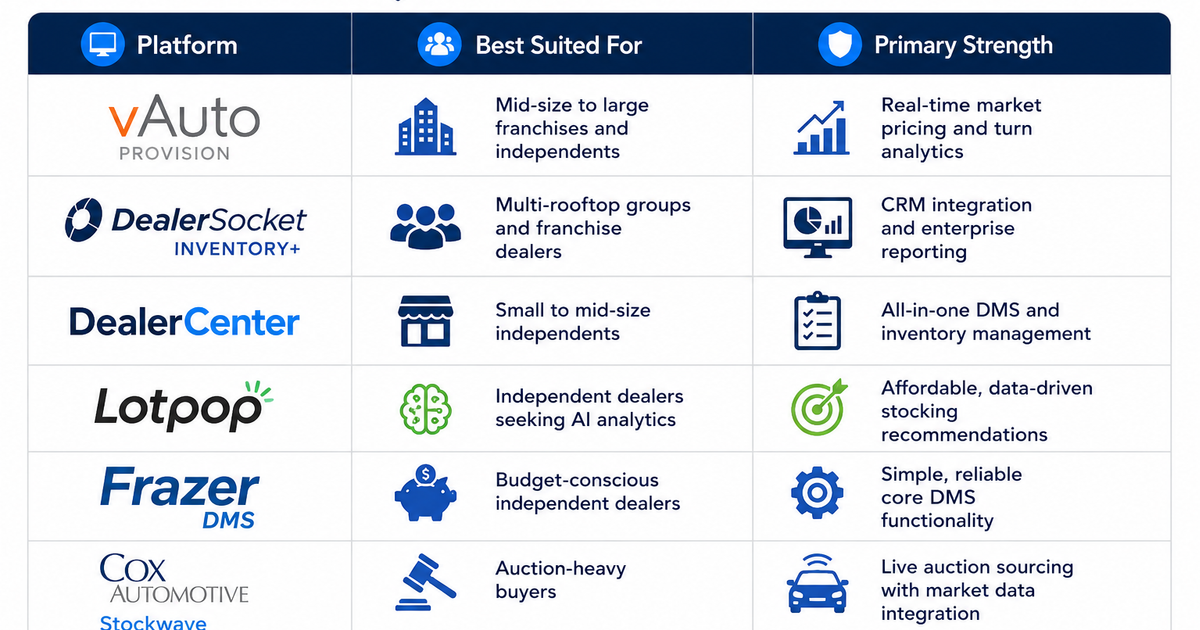
The U.S. market offers a solid range of platforms suited to different dealership sizes and operational needs. Here is a practical overview of the most widely adopted options:
Your selection should be based on your monthly unit volume, your current technology stack, and whether you need a standalone inventory tool or a fully integrated DMS solution.
For a step-by-step framework on evaluating these platforms, read how to choose the right used car inventory software.
Sources
- vAuto – https://www.vauto.com/
- DealerSocket – https://dealersocket.com/
- DealerCenter – https://www.dealercenter.com/
- Lotpop – https://www.lotpop.com/
- Frazer DMS – https://frazer.com/
- Stockwave – https://www.vauto.com/products/stockwave/
What to Prioritize When Evaluating Platforms
When comparing used car inventory management software for a U.S.-based dealership, the following criteria should drive your evaluation:
U.S. pricing guide integration. The platform must pull data from KBB, NADA Guides, and/or Black Book. These are the references your buyers use; your pricing tool needs to reflect the same market reality.
Auction feed connectivity. If you source inventory from Manheim, ADESA, or OVE, direct integration with those feeds is a baseline requirement, not a premium add-on.
Syndication coverage. Confirm that the platform syndicates to AutoTrader, Cars.com, CarGurus, and Facebook Marketplace as standard features before committing.
Mobile capability. Appraisals, recon walkarounds, and inventory checks do not happen only at a desk. A full-featured mobile app is an operational necessity for modern dealerships.
Total cost of ownership. Many platforms combine a monthly subscription with per-unit fees. Understand the full cost at your current volume before signing a contract.
U.S.-based customer support. Operational issues do not wait for business hours. Prioritize platforms that offer responsive, knowledgeable support from staff with actual dealer industry experience.
Sources
- Kelley Blue Book – https://www.kbb.com/
- Manheim – https://www.manheim.com/
- AutoTrader Dealer Solutions – https://www.autotrader.com/dealers/
The Financial Case: Understanding the ROI
Consider a dealership selling 60 vehicles per month with an average gross profit of $2,200 per unit.
Research from NIADA and Cox Automotive shows inventory software can improve gross profit by $150–$400 per vehicle.
At a conservative $200 improvement, that's:
- $12,000 additional monthly gross
- $144,000 annual increase
Most inventory platforms cost between $500 and $2,500 per month, making the payback period relatively short for many dealerships.
Sources
- NIADA – https://www.niada.com/
- Cox Automotive – https://www.coxautoinc.com/market-insights/
Conclusion
The used car business in America has never been more data-driven, and the dealers building sustainable, profitable operations are the ones who treat inventory management as a core business function — not an afterthought.
Used car inventory management software provides the pricing accuracy, operational visibility, listing quality, and reporting capability that independent dealers and franchise pre-owned operations need to compete effectively in today's market. It eliminates the inefficiencies that quietly drain gross profit, reduces the time vehicles spend moving from acquisition to sale, and gives dealers the insight to make consistently better buying and pricing decisions.
See how to scale your dealership with a BDC: scale-your-car-dealership-with-automotive-bdc.
If your current operation still relies on spreadsheets, manual listing updates, or a basic DMS that was not built for pre-owned inventory, upgrading to purpose-built used car dealer software is one of the highest-return investments available to you right now.
See our full roundup of the best software for used car dealers in 2026 .
Stop losing $500–$1,500 per vehicle to manual inefficiencies. Talk to our team about building a modern dealership tech stack.

Manan Bhalodia
Expert in automotive AI solutions and customer service optimization. Passionate about helping automotive dealerships leverage technology for growth.