Managing used car inventory has never been more challenging—or more important. While the average used vehicle spent 48 days on a dealership lot in Q3 2024, dealerships relying on manual inventory management often exceed that benchmark, tying up capital and reducing profitability. (Source: Auto Finance News via ACV Max)
At the same time, the used car market has become increasingly competitive. Limited vehicle supply, higher wholesale prices, and aggressive buying strategies from large dealership groups mean every inventory decision has a direct impact on revenue. (Source: CDK Global, 2025) Dealers can no longer afford delayed pricing updates, inaccurate stock records, or aging vehicles sitting unnoticed on the lot.
In today's market, success isn't determined solely by the vehicles you acquire. It's determined by how efficiently you manage, price, market, and sell them.
This is where the difference between manual inventory management and automated used car inventory management software becomes impossible to ignore. The gap between dealerships winning and losing in 2025 increasingly comes down to one operational choice — manual vs. automated inventory management.
Modern dealerships are moving beyond spreadsheets and paper-based processes toward intelligent platforms that provide real-time inventory visibility, AI-powered pricing recommendations, automated listings, and seamless integrations with Dealer Management Systems (DMS) and CRM platforms.
At the same time, inventory management is only one part of the sales equation. Solutions like Super Producer complement dealership inventory software by ensuring every lead interested in those vehicles receives timely, AI-powered follow-up before competitors have the chance.
In this guide, we'll compare manual and automated inventory management, explore the latest industry trends, examine the role of AI in dealership operations, and help you determine which approach positions your dealership for long-term growth.
The Used Car Market Has Changed—Has Your Inventory Process?
The automotive retail industry has evolved dramatically over the past few years.
What was once a relatively predictable inventory cycle has become a rapidly changing market driven by fluctuating wholesale prices, changing consumer demand, and tighter vehicle supply.
The numbers tell the story.
The global automotive appraisal and inventory management software market reached approximately $900 million in 2025 and is projected to grow to nearly $2.375 billion by 2033 — a compound annual growth rate (CAGR) of 12.9% — reflecting the growing reliance on digital inventory management solutions across dealerships. (Source: Congruence Market Insights, 2025)
Even more striking is the rapid adoption of artificial intelligence. The AI inventory management market alone is expected to reach $9.6 billion in 2025, up from $7.38 billion in 2024 — a 30.1% annual growth rate — as dealerships increasingly depend on predictive analytics and automation. (Source: Matellio, 2025)
Today, more than 72% of U.S. dealerships already use AI-assisted pricing and appraisal tools, while over 38,000 independent used car dealerships actively rely on digital inventory platforms to manage daily operations. (Source: Congruence Market Insights, 2024–2025)
These numbers aren't simply technology trends—they reflect a fundamental shift in how dealerships compete.
See how Super Producer would work your leads.
Why Inventory Management Matters More Than Ever
Several market forces have made inventory optimization a top priority for dealerships across the United States.
Limited Vehicle Supply
Although new vehicle production has improved since the pandemic, the effects of COVID-era manufacturing disruptions continue to impact the used vehicle market. Fewer lease returns and lower trade-in volumes have created a tighter supply of quality pre-owned inventory, keeping wholesale prices high and margins thin. (Source: CDK Global, 2025)
As a result, dealerships often pay more at wholesale auctions while having fewer opportunities to acquire profitable vehicles. Every purchase decision carries greater financial risk.
Higher Wholesale Prices
Rising acquisition costs have reduced profit margins for many dealerships. Overpaying for even a handful of vehicles can significantly impact monthly profitability. Instead of relying on instinct, successful dealerships now use live market data and predictive analytics to identify vehicles with the greatest profit potential before making purchasing decisions.
Increased Competition
Large dealership groups, online retailers, and digital marketplaces now compete directly with independent dealers for the same inventory. Vehicles often receive multiple bids before reaching auction. Without access to current pricing data and demand forecasts, smaller dealerships risk purchasing inventory that becomes difficult to sell profitably.
Customer Expectations Have Changed
Today's buyers begin their shopping journey online. They compare pricing across multiple websites, expect accurate vehicle information, and often make purchasing decisions before ever visiting a dealership. If inventory listings aren't updated quickly—or if pricing falls behind current market conditions—potential buyers move on to competing dealerships within minutes.
Digital Inventory Management Is Becoming the Industry Standard
Modern dealerships recognize that inventory is no longer managed once a week. It requires continuous monitoring.
Today's used car inventory management software automates many of the tasks that once consumed hours of employee time, including:
- VIN scanning during vehicle intake
- Real-time inventory tracking
- Automated pricing updates based on live market conditions
- Vehicle merchandising
- Listing syndication across major automotive marketplaces
- Inventory aging alerts
- Performance reporting and analytics
Instead of reacting to market changes after they happen, dealerships gain the ability to make proactive decisions backed by current data. This allows managers to reduce days on lot, improve inventory turnover, and maximize gross profit per vehicle.
Why Manual Processes Are Becoming a Competitive Disadvantage
Many independent dealerships continue relying on spreadsheets, handwritten appraisals, and disconnected software systems because those methods have worked for years. However, today's market moves too quickly for delayed information.
Every day a vehicle sits unsold represents additional carrying costs, depreciation, and lost opportunities. Likewise, every pricing error, duplicate listing, or missed follow-up creates an opening for competitors.
Dealerships that embrace automation aren't simply replacing manual tasks—they're creating faster workflows, better customer experiences, and more informed business decisions.
Before deciding whether your dealership should invest in inventory software, it's important to understand exactly how manual inventory management works—and why many dealerships continue using it despite its growing limitations.
How Manual Inventory Management Works
Despite the rapid growth of dealership technology, many independent used car dealerships still rely on manual inventory management. From spreadsheets and handwritten notes to disconnected software systems, these traditional processes remain common—especially among smaller dealerships with limited staff or inventory.
While manual workflows may seem familiar and inexpensive, they often create inefficiencies that directly affect profitability, customer experience, and inventory turnover.
Let's take a closer look at what manual inventory management actually involves and why more dealerships are transitioning to automated solutions.
Manual Inventory Management Actually Looks Like at a Car Dealership
The Manual Workflow
For many dealerships, managing inventory manually means handling nearly every stage of the vehicle lifecycle by hand — VIN logging in spreadsheets, handwritten appraisals, verbal or paper-based pricing updates, periodic lot walks, and manual cross-checking with accounting. Many smaller independent dealers still rely on spreadsheets, clipboards, and paper trail systems to run this process day to day. (Source: Autosoft DMS)
A typical process looks something like this:
Vehicle Acquisition
When a vehicle is purchased at auction or acquired through a trade-in, dealership staff manually record important information such as:
- Vehicle Identification Number (VIN)
- Make and model
- Trim level
- Mileage
- Purchase price
- Vehicle condition
- Acquisition source
This information is usually entered into spreadsheets, paper files, or multiple disconnected systems.
Vehicle Appraisal
Sales managers or buyers perform inspections and estimate vehicle values using printed pricing guides or online valuation tools. Pricing decisions often rely on experience rather than real-time market intelligence. Without automated pricing recommendations, vehicles can easily be:
- Overpriced and remain on the lot too long
- Underpriced and reduce gross profit
- Priced inconsistently across listings
Recon Tracking
Before vehicles reach the sales lot, they move through reconditioning, including mechanical repairs, detailing, safety inspections, photography, and marketing preparation. In manual dealerships, recon progress is typically tracked through whiteboards, spreadsheets, emails, or verbal communication. As a result, managers often spend valuable time asking questions like "Has service finished?" or "Are photos uploaded?" These communication gaps frequently delay vehicle availability.
Inventory Updates
Whenever pricing changes, repairs are completed, or a vehicle sells, employees must manually update records across multiple systems, including inventory spreadsheets, dealership websites, online marketplaces, CRM platforms, and accounting software. Each update increases the possibility of inconsistent information or human error.
Have questions about integrations?
Why Some Dealers Stick with Manual Systems
If automated inventory software offers so many advantages, why do thousands of dealerships still rely on manual processes? The answer usually comes down to four common reasons.
- Lower Upfront Costs — Many dealership owners believe spreadsheets are "free." Since they already have Microsoft Excel or Google Sheets, there appears to be no additional investment required. However, this perception often overlooks the hidden labor costs associated with manual data entry and inventory maintenance.
- Familiarity — Many dealerships have managed inventory the same way for years. Managers understand their existing processes and feel comfortable with them. Introducing new software can initially seem disruptive, even when it ultimately simplifies daily operations.
- Concerns About Learning New Technology — Some dealerships hesitate because they assume implementing inventory software requires lengthy training or complicated onboarding. In reality, many modern dealership platforms can be implemented within days and are designed with intuitive dashboards that require minimal training.
- Small Inventory Size — Independent dealerships with fewer than 50 vehicles sometimes assume inventory software is unnecessary. However, smaller inventories often mean tighter margins, making every pricing decision and every aging vehicle even more important. Automation helps maximize profitability regardless of lot size.
For a full breakdown of what this actually costs dealerships, see why every used car dealer needs inventory management software.
The Real Hidden Costs
Although manual inventory systems appear inexpensive on the surface, they create operational costs that are often much higher than dealerships realize.
Time.
Manual counts, spreadsheet updates, and data reconciliation drain staff hours — time that could be spent with buyers. According to CDK Global's 2025 Dealership Technology Study, the average dealership uses 12 disconnected software systems, with employees spending approximately 2.4 hours every day switching between applications and manually transferring information. (Source: CDK Global 2025 Dealership Technology Study)
No real-time data.
Dealerships that use manual systems are always making decisions with outdated information. By the time reports are updated, market pricing has changed, competing dealerships have adjusted pricing, consumer demand has shifted, and vehicles may already be aging. It's the equivalent of driving while looking in the rearview mirror. (Source: Autosoft DMS)
Human error.
Even experienced employees make mistakes. Common manual inventory errors include duplicate vehicle records, incorrect VINs, outdated pricing, missing inventory, listing sold vehicles online, incorrect mileage, and delayed inventory updates. Each mistake creates unnecessary friction for both employees and customers.
Space inefficiency.
Manual systems offer no clear overview of available lot space or unit velocity. Without centralized reporting, dealerships often struggle to answer important questions quickly: Which vehicles have been on the lot for more than 45 days? Which models are selling fastest? Which vehicles have the highest carrying costs? Which recon jobs are delayed? By the time these issues become obvious, dead inventory has already accumulated unnoticed and profit margins have declined.
What Used Car Inventory Management Software Actually Does
Modern used car inventory management software eliminates much of the manual work involved in dealership operations while providing real-time insights that help dealers make faster, smarter decisions. Instead of relying on spreadsheets, disconnected systems, and manual updates, dealerships can manage their entire inventory from a single platform.
Core Features of Modern Used Car Dealer Software
Real-Time Inventory Tracking
Every vehicle is tracked from acquisition through sale. Managers can instantly view vehicle location, stock status, recon stage, days on lot, current pricing, and marketing status. This visibility allows dealerships to identify bottlenecks before they affect profitability.
VIN Scanning and Automated Vehicle Intake
Rather than manually entering vehicle information, employees simply scan the VIN. The software automatically imports essential details, including year, make, model, trim, engine specifications, factory options, and vehicle history data (where available). This reduces manual entry while improving accuracy.
AI-Powered Market Pricing
One of the biggest advantages of automation is intelligent pricing. Modern platforms continuously monitor live market data from sources such as Kelley Blue Book (KBB), Black Book, NADA, local competitor listings, and auction data. Instead of guessing the right asking price, dealerships receive recommendations based on current market conditions, helping maximize both competitiveness and profit margins.
Automatic Listing Syndication
Uploading inventory manually to multiple websites is both time-consuming and prone to errors. Inventory management software automatically publishes vehicle listings across major marketplaces, including AutoTrader, Cars.com, CarGurus, dealer websites, and Facebook Marketplace (where supported). Any pricing or inventory changes update across all platforms simultaneously.
Recon Tracking
Instead of relying on phone calls or spreadsheets, dealerships can monitor each vehicle's progress through reconditioning in real time — which department currently has the vehicle, outstanding repair work, estimated completion dates, total recon costs, and time-to-frontline. This helps reduce delays and gets vehicles online faster.
AI Demand Forecasting
Advanced inventory platforms use artificial intelligence to analyze local buying trends, seasonal demand, auction pricing, vehicle popularity, and market supply. These insights help dealerships purchase inventory with greater confidence while avoiding vehicles likely to depreciate quickly.
Comprehensive Reporting Dashboards
Instead of manually building reports, dealerships gain instant visibility into critical performance metrics, including days on lot, gross profit per vehicle, inventory aging, inventory turn rate, recon timelines, acquisition costs, and sales performance. These dashboards support faster, data-driven decision-making across the dealership.
How It Integrates With the Broader Dealership
Modern inventory software doesn't operate in isolation. Most platforms integrate seamlessly with existing dealership technologies, including Dealer Management Systems (DMS), Customer Relationship Management (CRM) software, accounting platforms, digital retailing tools, and lead management systems. Integrated platforms also feed inventory data directly to digital retailing tools and vehicle detail pages (VDPs), and sync with accounting for real-time cost-of-inventory calculations.
Solutions like Super Producer complement these inventory platforms by integrating with systems such as DealerCenter, VinSolutions, and Frazer to automatically engage leads generated from your inventory. While inventory software helps dealerships manage and market vehicles, Super Producer ensures those interested buyers receive timely AI-powered follow-up, improving response times and helping sales teams convert more opportunities.
SourcesSeveral established platforms illustrate how automated inventory management shows up in the market today:
- vAuto (Provision) offers market-based pricing tools built primarily for franchise and large independent dealers. (Source: vAuto)
- Carketa is built for independent dealers and covers appraisal, recon, pricing, and vehicle sourcing in a single platform. (Source: Carketa)
- DealerCenter combines DMS, CRM, and inventory management in one system, popular among independent dealers. (Source: Podium, 2025)
- CDK Vehicle Inventory Suite applies predictive AI to pricing and acquisition decisions. (Source: CDK Global)
Manual vs. Automated Used Car Inventory Management: A Direct Comparison
Choosing between manual inventory management and automated software is no longer just a technology decision—it's a business decision that directly impacts your dealership's profitability, efficiency, and customer experience.
While manual processes may seem manageable for smaller operations, today's fast-moving automotive market requires real-time visibility, accurate pricing, and faster decision-making. Dealerships that continue relying on spreadsheets and disconnected systems often struggle to keep up with competitors using AI-powered inventory management tools.
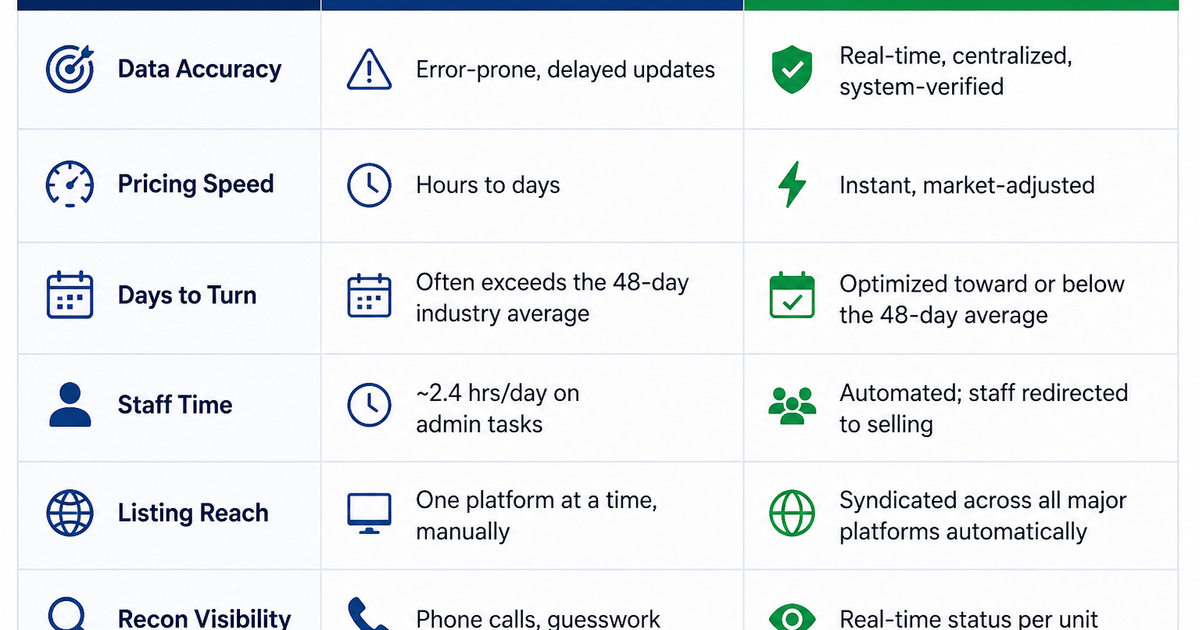
The table below highlights the key differences between the two approaches.
Data Accuracy Makes Better Business Decisions
Inventory decisions are only as good as the data behind them. When employees manually enter vehicle details, pricing information, and inventory updates, mistakes become inevitable. Duplicate entries, incorrect VINs, outdated pricing, and missing vehicles can all lead to lost sales and reduced customer trust.
Automated inventory software eliminates many of these issues by maintaining a single source of truth. Every department—from sales and service to accounting—works with the same real-time information, reducing confusion and improving collaboration.
Faster Pricing Means Higher Profitability
Used vehicle pricing changes daily. Auction results, consumer demand, local competition, and seasonal trends all influence vehicle values. Manual pricing often depends on periodic reviews, meaning dealerships may unknowingly leave vehicles overpriced or underpriced for days or even weeks.
Modern inventory management software continuously analyzes market conditions and recommends pricing adjustments based on real-time data. The results can be significant: dealers using vAuto Conquest have reported up to a 39% increase in new car sales after adopting AI-driven pricing and merchandising. (Source: vAuto)
Predictive AI tools can now forecast pricing 30 to 60 days out, helping dealers avoid overpaying at wholesale in a volatile market. (Source: CDK Global, 2025)
Reducing Days on Lot Improves Cash Flow
Every vehicle sitting on the lot ties up working capital. Beyond depreciation, dealerships continue paying floorplan interest, insurance, maintenance, advertising costs, and lot space expenses.
The industry average for used vehicle days-to-turn was approximately 48 days in Q3 2024. (Source: Auto Finance News via ACV Max) Automated inventory software helps dealerships stay at—or below—that benchmark by identifying slow-moving inventory early, recommending pricing adjustments, and highlighting units that require immediate attention.
The broader dealer management system (DMS) market — which underpins much of this automation — is projected to reach $10.76 billion by 2026, reflecting how central these platforms have become to dealership operations. (Source: Matellio)
Automation Gives Staff More Time to Sell
One of the most overlooked benefits of inventory software is productivity. Without automation, employees spend significant portions of their day updating spreadsheets, checking inventory counts, uploading listings, tracking recon status, and verifying pricing. Automation handles these routine processes in the background, allowing sales teams to focus on engaging customers, following up on leads, conducting test drives, and closing deals.
Multi-Platform Listing Syndication Expands Visibility
Today's buyers shop across multiple online marketplaces before ever visiting a dealership. Manually uploading vehicles to each platform is time-consuming and increases the likelihood of inconsistent information. Automated inventory software publishes listings simultaneously across major marketplaces, ensuring accurate pricing, updated vehicle availability, consistent descriptions, professional photos, and faster exposure to buyers.
Why AI-Powered Used Car Dealer Software Is Changing the Game in 2025
Inventory management is no longer just about tracking vehicles—it is about predicting market behavior. Artificial intelligence has become one of the most significant advancements in dealership operations.
Instead of relying solely on historical data or personal intuition, AI analyzes thousands of market signals simultaneously — consumer demand, local buying trends, auction activity, seasonal fluctuations, competitor pricing, and historical sales performance — shifting inventory decisions from gut instinct to data-driven acquisition. (Source: Matellio)
Predictive Inventory Planning
One of AI's biggest advantages is its ability to forecast demand. Instead of simply reporting what has already happened, AI predicts which vehicles are likely to sell fastest, which models are becoming less desirable, seasonal demand shifts, and expected pricing trends over the next 30 to 60 days. (Source: CDK Global, 2025) These insights help dealerships avoid overpaying at auction while stocking vehicles customers are actively searching for.
Smarter Acquisition Decisions
Buying the wrong vehicle can significantly reduce profitability. AI-powered inventory software evaluates multiple variables before recommending acquisitions, including current retail demand, regional market trends, expected depreciation, inventory shortages, and competitive pricing. Dealers can purchase with greater confidence instead of relying solely on experience or intuition.
Dynamic Pricing That Responds to the Market
Pricing is no longer a one-time decision. AI continuously monitors market conditions and recommends pricing adjustments as supply and demand change — a capability that has already reached mainstream adoption, with more than 72% of U.S. dealerships now using AI-assisted pricing and appraisal tools. (Source: Congruence Market Insights) Instead of reviewing pricing weekly, dealerships can remain competitive every day without constant manual effort.
Adapting to Changing Consumer Demand
Consumer preferences continue to evolve rapidly. Hybrid vehicles accounted for nearly 11% of U.S. market share by the end of 2024, and many dealerships have adjusted their EV inventory strategies — recalibrating away from EV stock toward hybrids — based on changing buyer demand. (Source: Montway Auto Transport, 2025) AI-powered inventory software helps dealerships identify these shifts early by analyzing live market activity, which is only efficiently possible with market-responsive software — allowing inventory decisions to stay aligned with what customers are actually buying.
Inventory Is Only Half the Sales Process
Managing inventory efficiently is essential—but selling those vehicles requires something equally important: timely lead follow-up. A dealership may have the right vehicles at the right price, but if incoming leads aren't contacted quickly, buyers will often purchase elsewhere.
Inventory software identifies what vehicles are available and ensures they're competitively priced. Super Producer complements that process by identifying engaged buyers, prioritizing active leads, automating follow-up conversations, and helping dealerships reconnect with prospects who might otherwise be lost.
Together, these technologies create a seamless sales process—from acquiring the right inventory to converting interested shoppers into customers.
H3: The Future Belongs to Connected Dealerships
The dealerships seeing the greatest success in 2025 aren't simply using more software—they're using integrated systems that communicate with each other. When inventory management platforms, CRM systems, DMS solutions, and AI-powered lead engagement tools work together, dealerships gain complete visibility into both inventory performance and customer activity.
This connected approach reduces manual work, improves operational efficiency, and creates a faster, more personalized buying experience. As competition continues to increase, dealerships that embrace automation and AI will be better positioned to improve inventory turnover, maximize gross profit, and build lasting customer relationships.
How to Choose the Right Used Car Inventory Management Software for Your Dealership
Investing in inventory management software is no longer just about replacing spreadsheets—it's about selecting a solution that supports your dealership's long-term growth. The right platform should simplify daily operations, provide actionable insights, and integrate seamlessly with the tools your team already uses.
Before making a decision, it's important to evaluate each solution based on your dealership's unique needs rather than choosing software solely based on price.
For a deeper evaluation framework, read how to choose the right used car inventory software.
Key Questions to Ask Before You Buy
Not all inventory management platforms offer the same features. Some focus primarily on inventory tracking, while others provide AI-powered pricing, forecasting, and reporting capabilities. Here are the most important questions to ask before choosing a solution.
Does It Integrate with Your Existing DMS and CRM?
Your inventory software should work with your current dealership management system instead of creating additional work. Look for integrations with platforms such as DealerCenter, VinSolutions, Frazer, Auto/Mate, and other leading dealership management systems. A connected ecosystem reduces duplicate data entry and ensures every department works from the same information.
Does It Offer Real-Time Market Pricing?
Vehicle prices change constantly. Choose software that continuously monitors market conditions and provides pricing recommendations using trusted automotive valuation sources such as Kelley Blue Book (KBB), Black Book, NADA Guides, local market listings, and auction pricing data.
How Does It Handle Recon Tracking and Time-to-Frontline?
Reconditioning delays are one of the biggest reasons vehicles remain off the lot longer than necessary. A quality inventory management platform should provide visibility into every stage of the recon process, including inspection, mechanical repairs, detailing, photography, and frontline-ready status. This transparency reduces bottlenecks and shortens time-to-market.
Does It Support Automated Multi-Platform Syndication?
Manually posting inventory to multiple websites wastes valuable time. Look for software that automatically distributes listings to major automotive marketplaces, ensuring every vehicle is consistently displayed with updated pricing, accurate descriptions, professional photos, and current availability.
Is AI-Based Demand Forecasting Built In?
Artificial intelligence is becoming a competitive necessity rather than an optional feature. Modern dealership software should offer AI capabilities such as demand forecasting, market pricing recommendations, inventory aging alerts, acquisition insights, and performance analytics.
What Does the Reporting Dashboard Look Like?
Data is only valuable if it's easy to understand. Look for dashboards that track important metrics such as days on lot per unit, gross profit per vehicle, inventory turn rate, aging inventory, acquisition costs, sales performance, and recon timelines.
Questions About Implementation
Technology adoption doesn't have to be complicated. Many dealership owners delay upgrading because they assume implementation will disrupt daily operations. Fortunately, modern inventory platforms are designed for quick deployment. Before purchasing, ask the vendor:
- What's the typical onboarding timeline? Most modern platforms go live within days, not weeks.
- Is pricing transparent? Watch for per-unit fees versus flat monthly pricing.
- Does it scale with your lot size, or does cost jump disproportionately as inventory grows?
- Is employee training included?
- What customer support is available?
- Is onboarding handled remotely?
- Are software updates included?
Red Flags to Watch For
Not every inventory management platform delivers the same level of functionality. Be cautious if a solution still requires:
- Extensive manual data entry
- Spreadsheet imports for daily operations
- Manual pricing updates
- Limited integrations with DMS or CRM platforms
- No mobile access for inventory checks or lot walks
- Long-term contracts without flexibility or performance benchmarks
- Outdated reporting dashboards
Software should simplify operations—not create additional work.
Inventory Software Alone Won't Maximize Revenue—Here's What Dealers Miss
Many dealerships invest heavily in acquiring the right inventory, optimizing pricing, and advertising vehicles across every major marketplace. Yet despite having the right cars at competitive prices, they still lose sales.
Why? Because inventory doesn't sell itself. Customers do.
A buyer may browse your website, view a vehicle multiple times, submit an inquiry, or request financing. If that lead isn't contacted promptly—or receives inconsistent follow-up—they'll often purchase from another dealership.
Speed and consistency of follow-up have a direct, measurable impact on dealership sales performance. According to Cox Automotive, Business Development Centers (BDCs) now handle 60–70% of all dealership leads, and the gap between a top-quartile BDC (an 18% close rate) and a bottom-quartile BDC (a 6% close rate) comes down almost entirely to process consistency. (Source: Cox Automotive via US Tech Automations)
This is where inventory management software and AI-powered lead engagement work together. Inventory software helps dealerships answer questions like: Which vehicles are available? Which units are aging? What should we price this vehicle? Which inventory should we acquire next? But it doesn't automatically nurture customer relationships.
That's where Super Producer fills the gap. One independent dealer in New Jersey put it plainly: "We had 200 leads in DealerCenter that nobody had touched in 45 days. Super Producer worked all of them in a weekend. We sold three cars." (Source: Super Producer)
Super Producer integrates with your existing dealership systems to identify active shoppers, prioritize high-intent leads, automate personalized follow-up, and re-engage prospects that sales teams may have overlooked. Instead of replacing your CRM or inventory software, Super Producer enhances them—ensuring every opportunity generated by your inventory receives timely attention.
Together, inventory management software and AI-powered lead engagement create a complete dealership growth strategy.
Conclusion: Manual Inventory Management Is a Margin Problem
The automotive industry has entered a new era where speed, accuracy, and data-driven decision-making determine who wins and who falls behind.
Manual inventory management may have worked when markets moved more slowly, but today's dealership environment demands real-time visibility, intelligent pricing, and streamlined operations. In a market with tightening used vehicle supply, rising wholesale costs, and more than 72% of U.S. dealers already using AI-assisted tools, manual inventory management is no longer a neutral choice—it's a competitive disadvantage.
Modern used car inventory management software helps dealerships:
- Improve inventory accuracy
- Reduce days on lot
- Optimize vehicle pricing
- Streamline reconditioning
- Increase operational efficiency
- Make smarter purchasing decisions
- Scale with confidence
However, inventory optimization is only one piece of the puzzle. The dealerships achieving the strongest results combine two layers:
- Used car inventory management software to track, price, and turn vehicles faster
- AI-powered lead follow-up tools like Super Producer to ensure the right buyers are reached before anyone else.
See the complete list of best software for used car dealers in 2026.
In today's competitive automotive market, success isn't just about managing inventory—it's about connecting the right inventory with the right customer before your competitors do.
Ready to see it live?

Manan Bhalodia
Expert in automotive AI solutions and customer service optimization. Passionate about helping automotive dealerships leverage technology for growth.