Most dealerships don't have a lead problem. They have a follow-up problem.
Between third-party lead providers, website form fills, chat transcripts, and inbound calls, the average dealership generates far more opportunities than its sales floor can chase down consistently. The gap between "lead generated" and "lead converted" is where a Business Development Center (BDC) earns its budget — and where most of a dealership's lost revenue quietly disappears.
This article breaks down exactly how a well-run automotive BDC moves the lead-to-sale conversion number, what levers actually matter, and how to tell whether your current BDC setup is helping or hurting.
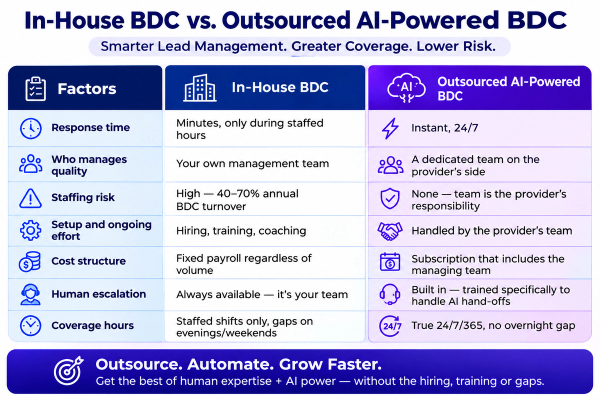
If you're still deciding whether to build this function in-house or bring in outside help, our companion guide — In-House vs. Outsourced AI-Powered BDC: Which Is Right for Your Dealership?— walks through that decision in detail. This piece assumes you already have (or are building) a BDC and want to know how to make it convert.
What Is an Automotive BDC?
A Business Development Center (BDC) is the dedicated team or function inside — or outsourced on behalf of — a car dealership that handles incoming leads, sets and confirms appointments, and manages ongoing customer follow-up, so that sales staff spend their time with buyers who are ready to walk the lot.
A dealership BDC typically owns:
- Inbound and outbound calls tied to sales and service leads
- Internet lead response (form fills, chat, third-party marketplaces
- Appointment setting and confirmation
- Follow-up cadences for unsold and "be-back" customers
- CRM data entry and lead status tracking
- In some structures, live chat and digital response as well
The BDC doesn't sell the car. It gets the right person into the store, at the right time, with the right expectations set — which is precisely why it has such an outsized effect on conversion rate.
For a deeper look at how this function is typically structured, see [What is Automotive BDC and Its Best Practices?].
Why Lead-to-Sale Conversion Is the Metric That Actually Matters
Dealerships track a lot of vanity numbers: total leads, total calls, total chats started. None of that matters if it doesn't turn into appointments that show up and show up that buy.
- Internet lead-to-sale conversion at most franchised dealerships sits in the low single digits — commonly cited in the 8–12% range for stores without a structured BDC process, versus meaningfully higher for stores with disciplined follow-up cadences.
- Response time is one of the single biggest predictors of conversion. Leads contacted within 5 minutes convert at dramatically higher rates than leads contacted after 30 minutes — a pattern documented repeatedly across B2C and automotive-specific lead-response studies.
- The majority of car buyers who submit a lead never hear back from a human within the first hour, and a meaningful share never hear back at all.
- The pattern across all of this: conversion is won or lost in the follow-up, not the ad spend. A BDC exists to close that gap systematically, rather than leaving it to whichever salesperson happens to notice the lead come in.
Source: https://leadlocate.com/sales-leads/automotive-lead-conversion-benchmarks
https://resources.insidesales.com/wp-content/uploads/2019/11/2014-Lead-Response-Report.pdf
See how fast a lead actually needs to be contacted to convert — and how Superproducer hits that window every single time - Book a Demo
The Core Levers a Dealership BDC Pulls to Improve Conversion
1. Speed to Lead
This is the single highest-leverage lever available. A structured automotive BDC treats first response time as a tracked, managed metric — not an incidental outcome. Most high-performing BDCs target first contact within 5 minutes for internet leads and immediate pickup (or fast callback) for inbound calls.
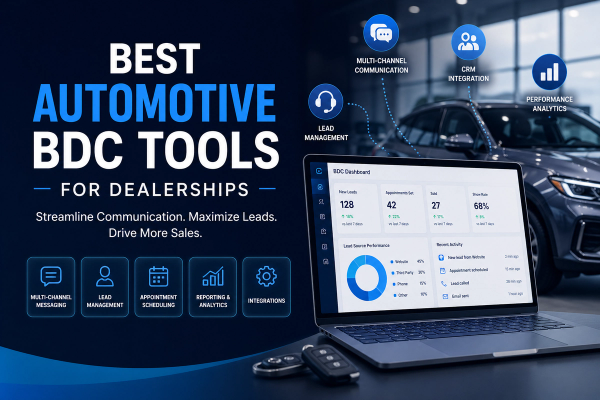
This is also where the right technology stack starts to matter — see [Best Automotive BDC Software for Dealerships] for what to look for.Source: https://www.callsource.com/automotive/data-insights/
2. Structured Follow-Up Cadence
One call and a voicemail is not a follow-up strategy. A properly run BDC works through a defined cadence — call, text, email, call again — across multiple days, because most buyers don't convert on the first touch. This is where in-house teams without dedicated BDC bandwidth typically fall down: sales staff are juggling floor traffic and let cadences lapse.
3. Appointment Setting and Confirmation
Setting an appointment is only half the job. Show rate is its own conversion lever, and BDC teams that confirm appointments the day before and the morning consistently post higher show rates than teams that set and forget.
4. Call Quality and Scripting
Untrained phone handling loses deals before a customer ever reaches the lot. BDC agents working from tested scripts — with objection handling for price shoppers, trade-in questions, and financing concerns — move more callers to booked appointments than ad hoc conversations.
5. CRM Hygiene and Lead Status Accuracy
A BDC is only as good as the data behind it. Leads that sit in "new" status because no one updated them after a call are leads that get skipped in the next follow-up pass. Clean CRM status tracking is unglamorous, but it's what keeps a follow-up cadence actually running rather than theoretically existing.
6. Digital Response Coverage
Live chat, SMS, and web form responses increasingly sit alongside phones in a modern BDC's remit. A customer who starts a chat at 9pm and gets a same-night reply is a different prospect than one who waits until the next business day. This is a smaller slice of total BDC volume for most stores, but it closes a real gap in coverage hours.
This is exactly what Superproducer's AI BDC handles — instant response, structured follow-up, and appointment confirmation, 24/7 Book a Demo
How to Measure BDC Success: The KPIs That Actually Matter
A BDC that only reports "calls made" isn't reporting outcomes. The metrics worth tracking:
- First response time (minutes from lead creation to first contact)
- Contact rate (% of leads reached at all)
- Appointment set rate (% of contacted leads that book)
- Appointment show rate (% of booked appointments that actually arrive)
- Lead-to-sale conversion rate (the number everything else exists to move)
- Cost per sold unit from BDC-sourced leads
If a BDC — in-house or outsourced — can't report on all six, you don't actually know whether it's working.
Follow-up cadence discipline is what actually keeps these numbers moving in the right direction — see [Why Follow-up is Necessary in Dealership Marketing] for why that's true.
The Rise of AI-Powered BDC for Car Dealerships
A newer layer worth understanding: AI-assisted BDC tools that handle initial lead response, qualify basic intent, and route hot leads to a human agent — often alongside or inside an automotive call center setup. These tools don't replace a BDC team; they extend coverage into hours and volume spikes a human team can't fully absorb, and they can shrink first-response time toward instant for digital leads specifically.
Dealerships evaluating an AI BDC for car dealerships solution should treat it the same way they'd evaluate any outsourced BDC service — by asking for actual conversion and show-rate data, not just response-time claims.
For a full breakdown of what this model actually includes — AI response plus a managed human team behind it — see Outsourced AI-Powered BDC: What It Is and Why Dealerships Are Switching.
Choosing an Automotive BDC Agency or Service Partner: What to Look For
Whether you're evaluating automotive BDC companies for the first time or replacing an underperforming partner, a few things separate real BDC experts from a generic call center wearing an automotive label:
- Automotive-specific scripting and objection handling — not generic customer service training
- Transparent, granular reporting tied to the KPIs above, not just call volume
- CRM integration with your existing DMS/CRM, not a parallel system you have to reconcile manually
- Defined response-time SLAs in writing, with accountability if they're missed
- References with dealership-specific case studies and conversion data, not just testimonials
For the full vetting checklist, see How to Choose the Right Automotive BDC Outsourcing Partner.
CTA: Not sure your current BDC is actually hitting these numbers? Let's look at your data together - Contact Us

Manan Bhalodia
Expert in automotive AI solutions and customer service optimization. Passionate about helping automotive dealerships leverage technology for growth.