A decade ago, "digital marketing for car dealerships" meant a website, a few Facebook ads, and a salesperson calling every lead who filled out a form. That playbook doesn't work anymore. Car shoppers now research on their own terms, across a dozen platforms, long before they ever walk into a showroom — and by the time they do, they expect the dealership to already understand what they want.
Artificial intelligence is what's making that possible. From auto sales advertising that targets the right buyer at the right moment, to an auto sales CRM that never lets a lead go cold, AI has quietly become the infrastructure behind modern auto dealership digital marketing. This guide breaks down exactly how — and what dealerships need to get right to benefit from it.
What Does "AI in Auto Sales Advertising" Actually Mean?
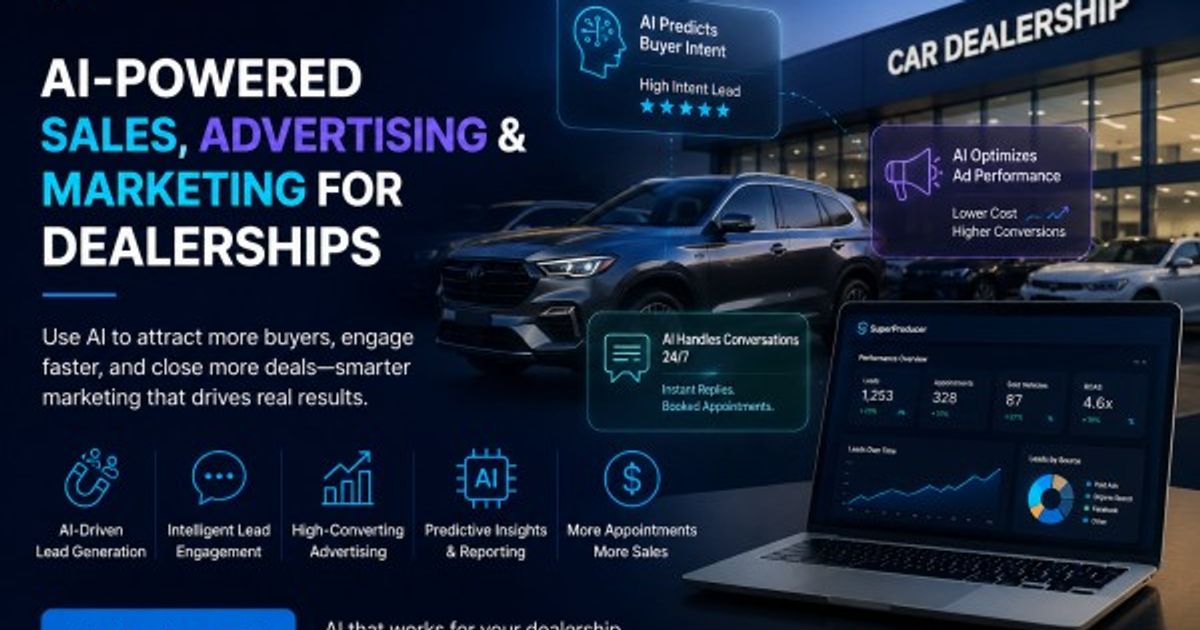
In simple terms, AI in auto sales advertising means using machine learning to decide who sees a dealership's ads, what those ads say, and when they're shown — instead of a marketer manually setting rules. AI tools analyze buyer behavior (search history, time on site, vehicle views, past purchases) to predict which shoppers are most likely to buy, then automatically adjust bidding, creative, and messaging to reach them. The result is advertising that gets sharper the longer it runs, rather than a static campaign a team sets once and rarely touches.
Why Dealerships Can't Afford to Ignore AI Anymore
Car buying has become an overwhelmingly digital process. Cox Automotive's Car Buyer Journey research — one of the longest-running studies of vehicle shopping behavior in the U.S. — has repeatedly found that the majority of a shopper's total vehicle-buying time is now spent online researching models, comparing prices, and reading reviews, well before they ever request a test drive. That shift has raised the bar for every dealership's marketing: if your ads, website, and follow-up don't feel personalized and fast, a shopper will simply move on to a competitor who does.
Response speed compounds the problem. In a widely cited lead-response study published by Harvard Business Review (Oldroyd, McElheran & Elkington, "The Short Life of Online Sales Leads"), companies that contacted a web lead within five minutes were nearly 100 times more likely to reach that lead, and 21 times more likely to qualify it, than companies that waited even 30 minutes. For dealerships fielding leads at night, on weekends, or across multiple listing sites, that's minutes most sales teams simply can't hit without automation.
At the same time, ad costs across Google, Meta, and Marketplace platforms keep climbing, and dealership margins on new vehicles remain thin. That combination — rising costs and a shopper who expects instant relevance — is exactly the problem AI is built to solve: doing more with the same (or a smaller) budget by cutting waste and reacting to buyer signals in real time.
How AI Is Changing Auto Sales Advertising
1. Predictive and Programmatic Ad Targeting
Traditional auto sales advertising relies on broad audience segments — "adults 25–54 within 20 miles." AI-powered programmatic platforms go much further, scoring in-market intent signals (recent vehicle searches, competitor site visits, loan calculator use) to identify shoppers who are actively ready to buy. This is often called predictive audience targeting, and it lets dealerships shift spend away from browsers and toward buyers, which is one of the fastest ways to lower cost-per-lead.
2. Dynamic, Inventory-Based Creative
AI-driven dynamic creative optimization automatically builds ad variations from live inventory feeds — pulling the right vehicle, price, mileage, and photo for each shopper based on what they've already viewed. This matters because Facebook Marketplace alone reaches well over a billion people every month, per Meta's own published usage figures, making it one of the largest pools of active used-car shoppers a dealership can reach — but only if the ad shown actually reflects current inventory. Instead of one generic ad for "2024 SUVs in stock," a shopper who looked at a specific trim sees an ad for that exact vehicle, updated automatically as inventory changes or a unit sells.
For dealers looking to automate this process further, 10 Proven Facebook Marketplace Tools to Sell Cars Faster covers the specific platforms that handle cross-posting and inventory sync automatically.
3. AI-Generated Ad Copy and Localization
Generative AI tools now draft and test dozens of headline and copy variations for search, social, and Marketplace ads, then use performance data to keep the strongest performers running. For multi-location dealer groups, this also makes localized advertising practical at scale — copy that adjusts by city, dealership name, and regional inventory without a marketer rewriting every ad by hand.
The Rise of the AI-Powered Auto Sales CRM
If advertising is how AI helps dealerships attract leads, the auto sales CRM is where AI helps them close more of them. A modern AI-powered CRM does far more than store contact records — it actively works the pipeline.
Lead Scoring and Prioritization
AI models score incoming leads based on behavior and fit — trade-in value, credit pre-qualification, page views, response speed to prior outreach — so BDC and sales teams know which leads to call first instead of working the list top to bottom.
Automated, Always-On Follow-Up
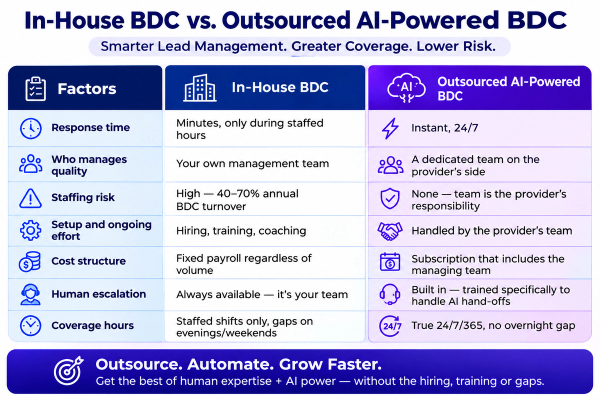
Response speed is one of the biggest predictors of whether a lead converts, which is exactly why the five-minute response window cited above matters so much. Most dealerships can't staff a BDC team 24/7, and AI-driven CRM tools close that gap with automated texts, emails, and conversational responses that engage a lead within seconds of a form submission — nights, weekends, and holidays included — then hand off to a human rep once the buyer is ready. This is a core reason we've previously covered why consistent, automated follow-up is non-negotiable in dealership marketing.
Predicting Purchase Timing
Beyond scoring a single lead, AI CRMs analyze patterns across thousands of past deals to predict when a shopper is likely to buy — surfacing "ready now" customers automatically and flagging longer-term nurture leads so the sales team isn't chasing cold prospects at the expense of hot ones.
Still working leads manually after the ad does its job?
See how an AI-powered CRM engages every lead within seconds, day or night.
AI's Role in Broader Auto Dealership Digital Marketing
SEO and AEO Content Optimization
AI tools now help dealerships and platforms identify what shoppers are actually searching for — and increasingly, what AI assistants like ChatGPT, Gemini, and Google's AI Overviews pull into their answers. This is where Answer Engine Optimization (AEO) and Generative Engine Optimization (GEO) come in: structuring content with clear definitions, FAQs, and data so that AI-driven search surfaces a dealership's content directly, not just a link buried on page two.
Conversational AI and Chat-Based BDC
AI chatbots on dealership websites and Facebook Marketplace listings now handle initial buyer questions, schedule test drives, and qualify trade-ins around the clock, extending what a human BDC team can realistically cover. Done well, this mirrors the best practices we've outlined in how automotive BDC works in modern dealerships — AI handles first response, humans close the sale.
Personalized Email and Retargeting
AI segments an email list far more precisely than manual rules allow — separating a shopper who abandoned a finance application from one who simply browsed inventory — and personalizes send time, subject line, and offer for each. The payoff is well documented outside automotive too: McKinsey & Company's research on personalization at scale has found that companies excelling at it generate significantly more revenue from those efforts than average performers, and can lower customer acquisition costs by as much as 50% while lifting marketing ROI by 10–30%. Paired with AI-driven retargeting ads, this keeps a dealership in front of a shopper across their entire research window, not just their first visit.
Wondering if your ads and follow-up are actually working together?
Super Producer connects AI-driven advertising with instant BDC response.
What the Data Shows About AI in Auto Retail
The shift toward AI in dealership marketing isn't anecdotal — industry and cross-sector research consistently backs it up:
• Cox Automotive — the majority of a shopper's vehicle research now happens online before any dealership visit, underscoring why digital advertising quality matters more than showroom traffic alone.
• Harvard Business Review (Oldroyd, McElheran & Elkington, "The Short Life of Online Sales Leads") — leads contacted within 5 minutes are up to 21 times more likely to qualify than those contacted after 30 minutes, the research finding that underpins why automated, instant follow-up matters so much for auto sales CRM performance.
• McKinsey & Company — effective personalization can cut customer acquisition costs by up to 50% and lift marketing spend efficiency by 10–30%, a pattern automotive marketers are now applying to ad targeting and CRM outreach.
• Meta / Facebook Marketplace — reaches over 1 billion people monthly across 70+ countries, making it one of the highest-volume channels for used-vehicle shoppers and a key reason inventory-accurate, AI-managed ads matter there specifically.
• Salesforce's State of the Connected Customer research has repeatedly found that the large majority of customers expect personalized engagement and are more likely to buy from companies that deliver it — a bar AI-driven CRM and advertising tools are built to meet.
For dealers looking to act on these numbers with a connected marketing plan, Marketing for Car Dealerships: The Complete 2026 Guide to Driving More Leads and Sales lays out how these pieces fit together.
Common Mistakes Dealerships Make When Adopting AI
AI can only help a dealership as much as it's implemented correctly. The most common missteps echo the patterns from our common mistakes in auto sales advertising article:
• Turning on AI ad targeting but never feeding it clean, updated inventory data — leading to ads for vehicles that already sold.
• Using an AI CRM for lead scoring but keeping a slow, manual follow-up process, which cancels out the speed advantage the data above shows matters most.
• Treating AI-generated content and ad copy as "set and forget" instead of reviewing it for accuracy, tone, and compliance.
• Ignoring AEO/GEO content structure, so AI search assistants can't easily surface the dealership's own content when shoppers ask questions.
• Rolling out AI tools without training the BDC or sales team on how to work alongside them, rather than around them.
How Super Producer Brings AI-Driven Advertising and CRM Together
This is exactly the gap Super Producer is built to close for U.S. dealerships. Rather than treating advertising and CRM as separate systems, Super Producer combines AI-powered automotive BDC capabilities — instant lead response, intelligent lead scoring, and automated follow-up — with the advertising intelligence to make sure that follow-up is working on leads that were targeted well in the first place.
For dealerships juggling Facebook Marketplace, third-party listing sites, and their own website, that means fewer leads slipping through the cracks and a sales team that spends its time on the buyers most likely to close — not on manually sorting through a CRM.
Ready to connect your BDC, inventory, and follow-up into one system?
See what Super Producer can do for your dealership.
Conclusion
AI isn't a future trend for auto dealership marketing — it's already the difference between dealerships that convert online research into showroom visits and those that lose shoppers to faster, more relevant competitors. From auto sales advertising that targets real buyers rather than broad demographics to an auto sales CRM that never misses a follow-up, AI is now core infrastructure, not an add-on.
Dealerships that pair the right AI tools with a well-trained team — and avoid the common implementation mistakes above — are the ones seeing results where it matters most: more leads converted, faster response times, and more cars sold.
Ready to see how AI-powered automotive BDC can work for your dealership? Book a demo with Super Producer or contact us today to get started.

Manan Bhalodia
Expert in automotive AI solutions and customer service optimization. Passionate about helping automotive dealerships leverage technology for growth.